

You decide to learn French on a Sunday evening. By Monday morning you have an app with a streak, three YouTube playlists, a PDF of 500 words and a friend telling you to just move to Paris. You still have no idea what to do on Tuesday.
That pile is the real problem. French for beginners comes with plenty of material and very little order. This guide gives you the order: what to do first, what comes next, and how to give your practice a target.
The short answer: To learn French from scratch, start with the sounds, then build a small set of sentences you can say without looking, then practice them aloud with a real person every week. Pick an exam date, such as the DELF A1, so your practice has a target. Spread your hours across the week instead of cramming them into one day.
What does it mean to learn French from scratch?
It means you start at A1, the first of the six CEFR levels, and your first goal is small. The Council of Europe describes A1 as using everyday phrases, saying who you are, and answering simple questions about where you live and who you know. The detail that matters most is the last one: you can manage this “provided the other person talks slowly and clearly” (Council of Europe, CEFR global scale). So A1 is defined by talking to someone, not by how many words you have memorized.
Fluency is a long way past that, and nobody honest sells it as a first-month result. Our guide to French language levels explains A1 to C2 by goal.
How do you learn French from scratch, step by step?
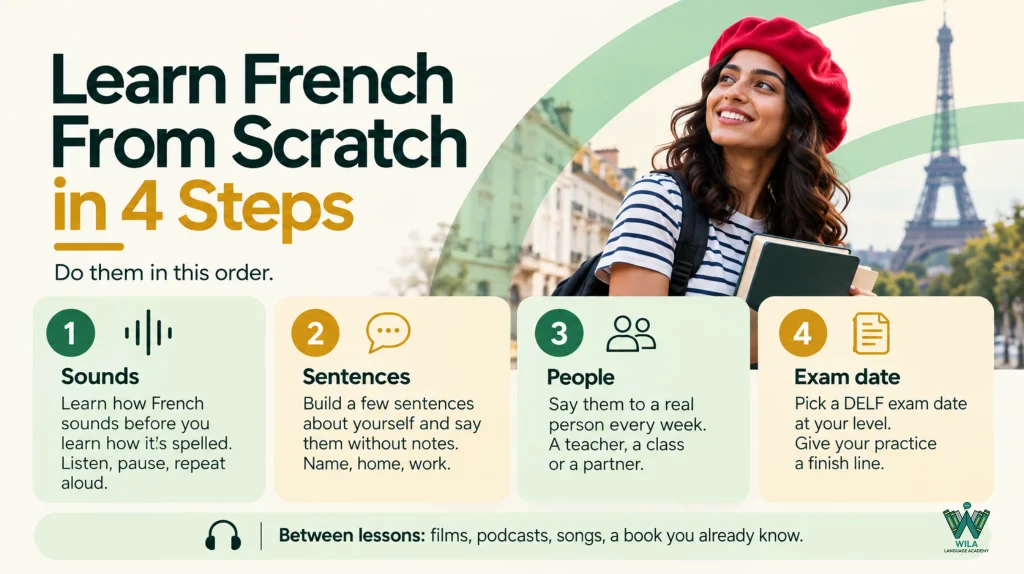
Learn French in four steps, in this order, because each step makes the next one cheaper.
| Step | What you do | You can move on when |
|---|---|---|
| 1. Sounds | Learn the alphabet, the nasal vowels, the French r and the silent endings, by listening and repeating | You can read a short French word aloud and a French speaker understands you |
| 2. Sentences | Build a small set of sentences about yourself and say each one aloud until it needs no notes | You can give your name, home, work and one plan without looking |
| 3. People | Say those sentences to a real person every week: a teacher, a class or an exchange partner | You can keep a slow exchange going for a minute or two, asking and answering |
| 4. Proof | Book a DELF exam date at your level, so your practice has a finish line | You have a date, and a practice paper you can finish |
Step 1: Learn the sounds before the spelling
French is written one way and said another. Take je parle, tu parles and ils parlent: three spellings, one sound. Or oiseau, which has six letters and four sounds, roughly “wa-zo”. If you learn words from the page first, you will say them the way the spelling suggests and wonder why nobody understands you.
You do not need a perfect accent. The Council of Europe’s pronunciation guidance says being understood matters far more than sounding native, and its newer scale dropped the native-speaker target (Council of Europe, phonological competence). So give your first week or two to listening, pausing and repeating out loud.
Step 2: Build sentences, not word lists
A list of 500 words gives you 500 things you cannot use yet. One sentence you can say gives you a pattern you can reuse. A1 is about introducing yourself and answering simple questions, so build exactly those:
- Je m’appelle Arun. (My name is Arun.)
- J’habite à Bengaluru. (I live in Bengaluru.)
- Je travaille dans une banque. (I work in a bank.)
- J’ai deux frères. (I have two brothers.)
Swap one word and you have a new sentence: J’habite à Chennai. Je travaille dans un hôpital. Say each one aloud twice before you move on.
An AI chatbot can drill these with you at any hour: ask it to act as a French tutor, ask one question at a time and explain your mistakes in English. It cannot reliably hear your sounds, which is why Step 3 stays.
Step 3: Say them to a real person every week
This is the step most self-study plans skip, and it is the one A1 is built around. An app never interrupts you, never mishears you and never waits through your silence. A person does all three, and that is the situation you are learning for.
Your options are a teacher in a live class, a tutor, or a language-exchange partner. Whoever it is, they should hear you at least once a week and be able to correct the sounds you worked on in Step 1.
Between lessons: keep French around you
You will not speak French for hours a day, but you can hear and read it. Watch a film or series you already know in English, first with English subtitles, then with French ones. Play a beginner podcast or a French song while you cook. Try a slowed-down learner news bulletin, such as RFI’s Journal en français facile, because ordinary French news runs too fast at A1. And read a short book you already know in English, so the story carries you through the words you do not know.
You will not understand everything, and you are not meant to. The aim is to get your ear used to the rhythm. Once your Step 2 sentences feel easy, add a daily journal of three to five sentences.
Step 4: Give your practice a finish line
A certificate proves your level to someone who cannot sit in on your conversations, and an exam date gives your weekly practice a deadline. The certificate section below explains which paper to pick.
Should you learn French online, in a class near you, or on your own?
Choose by who will make you speak, not by what looks cheapest or most convenient.
| Route | Good for | Usually weak at |
|---|---|---|
| Apps and video courses | Daily contact, vocabulary, Steps 1 and 2 | A live person who answers back and corrects your sounds |
| French classes near me, in person | A fixed routine and a room without distractions | Only the batches and timings nearby |
| Online French classes, live | A choice of teacher and level wherever you live, flexible timings | Needs a quiet spot and the habit of turning up |
If you want to learn French online, pick a live class or tutor, not recordings alone. Recordings help you revise, but they cannot listen to you. We compare the two in classroom vs online language courses.
Which French level do you need for your goal?
A1 is where you start, not where most goals end. The Council of Europe describes each level by what you can do, which makes it easy to match a level to a plan.
| Your goal | Level to aim for | Why |
|---|---|---|
| Simple chats, shopping and basic travel | A2 | CEFR A2: simple, routine exchanges about shopping and local geography |
| Getting by on a trip without a guide | B1 | CEFR B1: most situations likely to arise while travelling |
| Studying in France | B2, sometimes C1 | Campus France: most universities ask for B2 (DELF or TCF-DAP), a few for C1 |
| Working in French | Ask the employer | Roles differ, so take the level from the job posting |
Treat the table as a starting point. Your exact programme or employer sets the real requirement, so check it before you pick a course (Council of Europe, Campus France).
Which certificate should you aim for when you learn French online?
A certificate gives your learning a finish line. There are two very different pieces of paper, and people mix them up.
| Paper | Who issues it | What it shows |
|---|---|---|
| Course completion certificate | The school you studied with | That you finished that school’s course |
| DELF diploma (A1 to B2) | The French Ministry of Education, through authorized exam centres | Your level on the CEFR scale, as an official result |
A course certificate is a fair record of your effort. A university, employer or immigration office that wants proof of your French will usually name an official exam instead. For the first level that is the DELF A1, which you sit at an authorized centre such as the Alliance Française de Bangalore, and which that centre lists as valid for life. If you already know why you are learning French, look at the exam dates early and work backwards from one.
Some routes name other exams, such as the TCF or TEF, so read the exact requirement before you pay for anything. Our DELF A1 exam preparation guide covers the first diploma in detail.
How WILA Languages can help you learn French
If Step 3 is your gap, that is the job of a live class. WILA Languages teaches French from A1 to C2 in live, instructor-led classes aligned to the CEFR, online or in the classroom. Batches are capped at 12 learners, and there is a weekly speaking club.
The French A1 course has 60 guided hours. It starts with the alphabet and sounds in week one, moves through introductions, daily routine, food and shopping, and ends with a full DELF A1 practice exam. A short diagnostic before enrolment tells you where to begin, and you can book a free demo class first.
FAQs
1.How many hours a week do you need to learn French?
There is no fixed number, so pick a rhythm you can keep. As a benchmark, Cambridge suggests about 90 to 100 hours of lessons and supervised study for a complete beginner to reach A1. It writes that figure for its English exams, calls it a guideline only, and says your language background, how intensely you study, your age and how much you practice outside lessons all change it (Cambridge English).
At five hours a week, 90 to 100 hours is roughly 18 to 20 weeks. Spacing helps: in a 2024 study of 116 Japanese learners of English (not French, and not total beginners), practicing once a week gave about the same fluency gains as practicing every day (Kakitani and Kormos, 2024). It is one study, but a weekly slot you keep beats a daily plan you drop. For timelines by level, see how long it takes to learn a language.
2. Is French easy to learn for Indians, and is it hard from scratch?
It is manageable, and you have one advantage if you already read English: English and French share many word roots, so a lot of written French looks familiar. The US Foreign Service Institute puts French in its easiest language group, though that group is defined by closeness to English and was built for American diplomats (US Department of State). The hard part is the same for everyone: sound against spelling, which is why Step 1 comes first.







