


Learning a new language can take a few months to reach basic communication and several years to develop advanced proficiency. There is no single timeline that applies to everyone.
The bigger question is what you mean by “learn a language.” Being able to introduce yourself, order food, and ask for directions requires much less time than being able to study, work, or have complex conversations in that language.
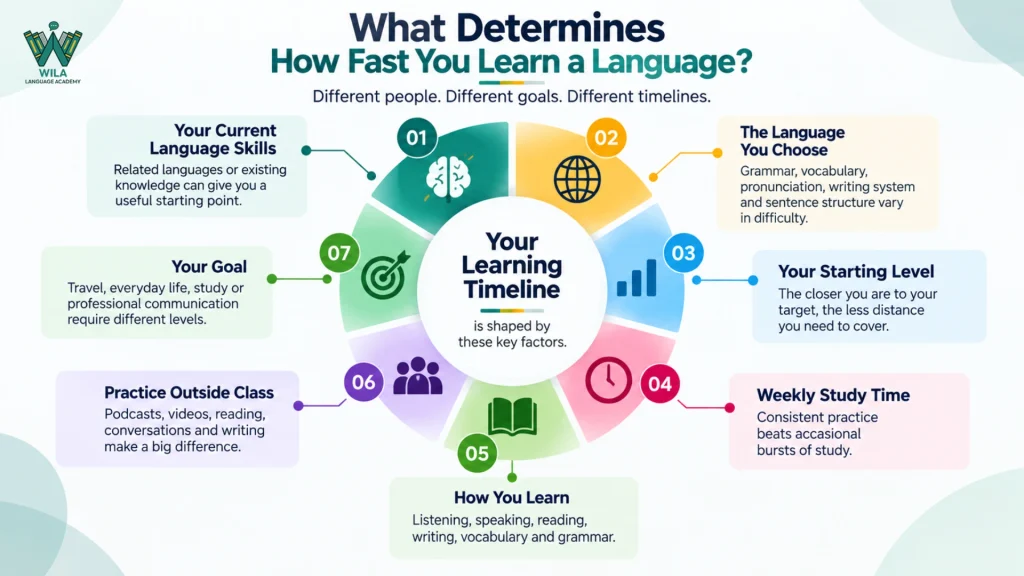
Your timeline also depends on the language you choose, your starting point, how much time you study, how you practice, and what level you want to reach. This is the first thing to settle before you try to learn a language: what does success actually look like for you?
How Long Does It Take to Learn a Language?
There is no fixed number of days or months required to learn a language.
For a more useful estimate, you need to define a target level. The Common European Framework of Reference for Languages (CEFR) provides six commonly used levels, from A1 to C2, based on what a learner can actually do with the language.
Learning a new language can take a few months to reach basic communication and several years to develop advanced proficiency. There is no single timeline that applies to everyone.
The bigger question is what you mean by “learn a language.” Being able to introduce yourself, order food, and ask for directions requires much less time than being able to study, work, or have complex conversations in that language.
Your timeline also depends on the language you choose, your starting point, how much time you study, how you practice, and what level you want to reach. This is the first thing to settle before you try to learn a language: what does success actually look like for you?
How Long Does It Take to Learn a Language?
There is no fixed number of days or months required to learn a language.
For a more useful estimate, you need to define a target level. The Common European Framework of Reference for Languages (CEFR) provides six commonly used levels, from A1 to C2, based on what a learner can actually do with the language.
| CEFR level | What you can generally do |
|---|---|
| A1 | Use basic expressions, introduce yourself, and handle very simple interactions |
| A2 | Communicate in simple routine situations and discuss familiar topics |
| B1 | Handle many everyday situations and communicate about familiar subjects with more independence |
| B2 | Communicate with greater fluency and discuss a wider range of concrete and abstract topics |
| C1 | Use the language fluently and flexibly for social, academic, and professional purposes |
| C2 | Understand and express complex ideas with a high degree of precision |
These descriptions come from the CEFR’s “can-do” approach. They are useful because they give you a clearer target than simply saying, “I want to be fluent.”
Cambridge English notes that motivated adult learners typically need around 100 to 200 hours of guided learning to move from one CEFR level to the next, although the actual time varies. Its estimates put the move from A1 to A2 at roughly 100 to 150 guided learning hours, while progressing from B1 to B2 can require around 180 to 260 hours.
- Cambridge English: Around 100 to 200 guided learning hours per CEFR level, depending on the level and learner.
- U.S. Department of State’s Foreign Service Institute (FSI): Groups languages into difficulty categories based on the training time typically required for English-speaking learners, with easier languages such as French and Spanish requiring fewer hours and more difficult languages such as Arabic, Chinese, Japanese, and Korean requiring substantially more.
Important: These are benchmarks, not guaranteed timelines. Progress varies based on factors such as prior language experience, ability, study intensity, and learning method. Higher proficiency generally requires more time and practice.
For a full breakdown of what each of these CEFR Levels involves and how they build on one another, see our complete guide to CEFR Levels.
What Does “Learning a Language” Actually Mean?
Imagine two people saying:
“I want to learn Spanish.”
The first person wants to travel to Spain and handle restaurants, hotels, shopping, and basic conversations.
The second person wants to study at a Spanish-speaking university and participate confidently in academic discussions.
They are learning the same language, but they do not have the same goal.
That is why asking “How long does it take to learn a language?” without defining the goal can be misleading.
“How long it takes” depends largely on what you want to do with the language. Your target might look like this:
| Goal | What you may be able to do | Approx. CEFR range |
|---|---|---|
| Basic communication | Introduce yourself, ask simple questions, order food, and handle basic interactions | A1 to A2 |
| Everyday independence | Hold conversations, discuss familiar topics, read simple content, and manage daily situations | B1 |
| Professional or academic communication | Follow detailed discussions, explain complex ideas, write structured content, and communicate effectively at work or in study | B2 to C2 |
This is why “fluency” is not a precise finish line. Instead of aiming vaguely to become fluent, define the situations in which you need to use the language and choose a target level accordingly. Chasing language fluency as a vague, undefined goal makes it harder to know when you have actually arrived, which is exactly why a CEFR target works better.
What Factors Decide How Long It Takes to Learn a Language?
Two learners can spend the same number of hours studying the same language and still progress at different rates.
Here are the biggest reasons why.
Reason #1: Your Current Language Skills
The languages you already know can affect how quickly you learn another one.
You may already understand certain grammar concepts, recognize similar words, or be familiar with sounds that appear in your new language.
For example, someone who has already learned a language with a similar vocabulary or grammatical structure may find some parts of another related language easier.
This does not mean one language will automatically be easy for you. It simply means your existing knowledge can give you a useful starting point.
Reason #2: The Language You Are Learning
Not every language presents the same challenges to every learner.
The difficulty can come from differences in:
- Vocabulary
- Grammar
- Pronunciation
- Writing system
- Sentence structure
- Word order
- Listening patterns
Your first language also matters. A language that feels familiar in its sounds or sentence structure may require less adjustment than one that is very different from what you already know.
So there is no universal answer to questions such as “What is the easiest language to learn?” The answer depends partly on what you already know.
Reason #3: Your Starting Level
A complete beginner and an intermediate learner are not starting from the same place.
If you already know basic vocabulary and grammar, you may be able to move towards the next level without starting from scratch.
This is also why language courses often use placement assessments. The right starting point is not always the first level.
Your timeline should therefore be based on the distance between your current ability and your target, not simply the total number of levels in the language.
Reason #4: How Much Time You Study Each Week
The total amount of learning time matters, but consistency matters too. This is where most of your language learning time actually gets used, so it deserves more attention than the total hour count alone.
Consider two learners:
Learner A
- Studies for 30 minutes every day
- Reviews vocabulary regularly
- Speaks several times a week
Learner B
- Studies for five hours once every two weeks
- Rarely reviews previous lessons
- Has little exposure between sessions
It is difficult to identify every mistake yourself.
A teacher, speaking partner, or structured learning programme can help you identify problems with pronunciation, grammar, vocabulary, and sentence formation.
Feedback is especially important when you are trying to build accurate speaking and writing habits.
7. Use the language beyond your lessons
Your formal lesson is only one part of the learning process.
Try to create small opportunities to use the language throughout the week.
For example, after learning vocabulary related to food, use it while reading a menu, watching a cooking video, or describing what you ate.
The more often you connect new language to real situations, the more useful your practice becomes.
Learn Foreign Languages with WILA Languages
Learning a language becomes easier to manage when you have a clear path from your current level to your target. If you’d rather follow a structured plan than figure it out alone, this is generally the fastest way to learn a language on a realistic timeline, rather than guessing your way through apps and free resources alone.
WILA Languages offers CEFR-aligned German, Spanish, and French programmes from A1 to C2, with instructor-led learning, speaking practice, structured progression, and preparation for recognized language examinations.
The right course depends on your starting level and your goal. If you are a complete beginner, you can start at A1. If you already have language knowledge, a level assessment can help determine where you should begin.
Whether you are learning for study, work, travel, or life abroad, a structured course can give you a clearer path and regular opportunities to practice. If you’re still weighing whether it’s worth it at all, our piece on the benefits of learning a foreign language covers the broader case beyond just timelines.
FAQs About Learning a New Language
1.Can I learn a new language in 3 months?
You can make meaningful progress in three months, especially if you study consistently and have a clear goal. However, reaching a specific CEFR level depends on your starting point, study time, language, and learning method. Three months should be viewed as a period for measurable progress, not a guaranteed path to fluency.
In short, three months is enough time to make visible progress, but not a guarantee that you will fully learn a language to an advanced level.
2. Can I learn a language by studying 30 minutes a day?
Yes. Thirty minutes a day gives you regular exposure and can build useful progress over time. The key is consistency and how you use those 30 minutes. Combining vocabulary, listening, speaking, reading, and review is more useful than spending every session on the same type of exercise.
3. Is it possible to become fluent in a language in one year?
It is possible to make substantial progress in a year, but “fluent” does not have one universal definition. The level you reach will depend on your starting point, the language, the amount of time you invest, and how much real practice you get. A specific CEFR target is more useful than an undefined goal of fluency.
4. Is learning a language harder for adults?
Adults can successfully learn new languages. The learning process may differ from childhood language acquisition, but adults can benefit from existing knowledge, study strategies, clear goals, and structured practice. The time required still varies significantly between individual learners.
5. What is the fastest way to learn a new language?
The fastest approach is usually not one particular app or technique. Set a clear target, study consistently, practice speaking and listening, learn vocabulary in context, use the language regularly, and get feedback on your mistakes. A structured learning programme can also help you avoid wasting time on areas that are not relevant to your goal.
6. Which language should I learn for my career?
The right language depends on where you want to study, work, or build your career. German, Spanish, and French can each serve different academic, professional, and migration goals. Start by identifying the countries, industries, or opportunities you are targeting, then choose the language that supports that plan. For a deeper side-by-side comparison of German, French, Spanish, and other options by career fit, see our guide on choosing the best foreign language for your career.
7. Do I need to study every day to learn a language?
You do not have to study every single day, but regular practice can make it easier to maintain momentum. A consistent schedule that you can follow for months is usually more useful than occasional intensive study followed by long gaps.
8. How long does it take to learn German, Spanish, or French?
There is no single timeline for any of these languages. Your starting level, target CEFR level, previous language experience, study schedule, and learning method all affect the time required. The best estimate comes from defining your target level and then planning the learning hours needed to reach it. For a level-by-level breakdown specific to German, see our guide to German language levels from A1 to C2.







