
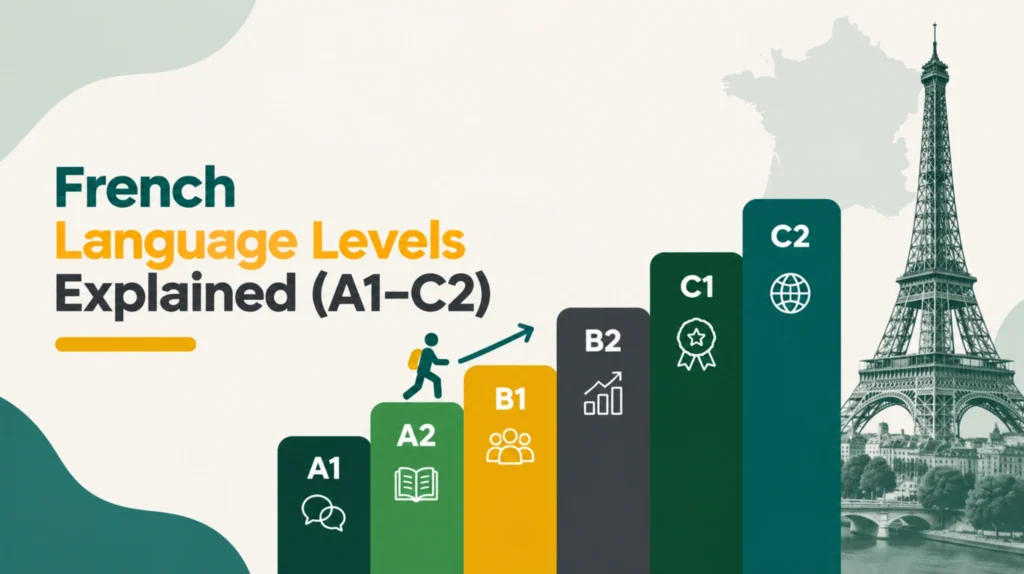

You are on a French course sign-up page, a university admissions list, or a Canada PR checklist, and it asks for a level. B1. B2. DELF. TCF. You know you want to learn French. You are just not sure which of these labels is the one you actually need.
That is the useful way to read the French Language Levels. Not as a ladder you climb from A1 to C2 for its own sake, but as a set of targets tied to what you plan to do. A trip needs one level. A French master’s needs another. A work permit in Canada needs a specific exam, not just a level.
So start from your goal, find the level it asks for, then pick the exam that proves it. This guide walks that path, in that order.
What are the French language levels?
French levels come from the CEFR, the Common European Framework of Reference for Languages. It sorts ability into six levels across three bands, based on what you can do in reading, listening, writing and speaking. It is not a grammar syllabus. It describes what you can handle, not which tenses you have studied.
| Band | Levels | In plain terms |
|---|---|---|
| Basic user | A1, A2 | Simple, everyday exchanges |
| Independent user | B1, B2 | Manage on your own in most situations |
| Proficient user | C1, C2 | Handle demanding material with ease |
You climb ability roughly in order, but you do not have to certify every step. Your goal sets the target. Everything below helps you find it.
Which French level do you need?
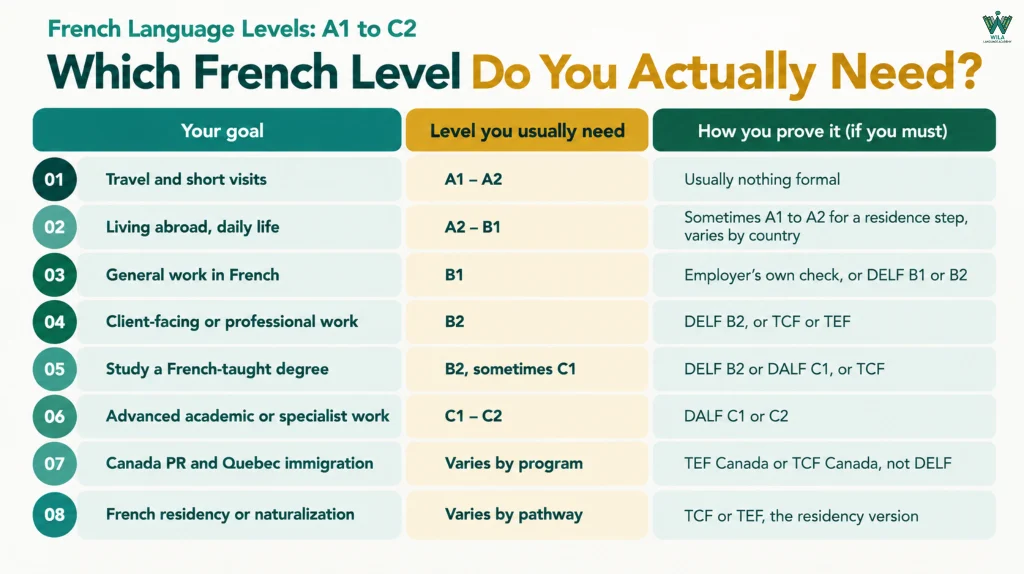
The quickest way to use the French Language Levels is to work backwards from what you want French for. Find your goal in the table, and it points you to the level you usually need and the exam that proves it, if any.
| Your goal | Level you usually need | How you prove it (if you must) |
|---|---|---|
| Travel and short visits | A1 to A2 | Usually nothing formal |
| Living abroad, daily life | A2 to B1 | Sometimes A1 to A2 for a residence step, varies by country |
| General work in French | B1 | Employer’s own check, or DELF B1 or B2 |
| Client-facing or professional work | B2 | DELF B2, or TCF or TEF |
| Study a French-taught degree | B2, sometimes C1 | DELF B2 or DALF C1, or TCF, set by the university |
| Advanced academic or specialist work | C1 to C2 | DALF C1 or C2 |
| Canada PR and Quebec immigration | Varies by program | TEF Canada or TCF Canada, not DELF |
| French residency or naturalization | Varies by pathway | TCF or TEF, the residency version |
Here is why the goal comes first. Two people both want to work in France. One will fix machines on a factory floor with a mostly non-French team. The other will handle French clients on calls all day. The first can get by around B1. The second needs B2 just to do the job. Same country, same language, different level, because the situations are different.
Pick the goal, read what it truly asks for, and you often need less than you feared. Many learners chase C1 when nothing in their plan ever asks for more than B2.
One caution that applies to the whole table: requirements change and vary by country, university and program. Treat every level here as a common starting point, then confirm the exact requirement from the official source before you commit.
What can you do at each French level (A1 to C2)?
Once you know your target within the French Language Levels, here is what each one means in practice.
| Level | What you can do | Where it fits |
|---|---|---|
| A1 | Introduce yourself, ask simple questions, handle basic needs | Travel, first steps |
| A2 | Talk about routines, the past and plans in simple terms | Everyday situations, some residence steps |
| B1 | Follow familiar topics, give opinions, cope in most daily and work situations | General work, social life |
| B2 | Follow detailed discussion, argue a point, work in French with confidence | Professional roles, most French-taught study |
| C1 | Handle complex, implied and specialist material, adjust your tone | Demanding study and work |
| C2 | Understand almost everything, express fine shades of meaning | The most demanding academic and professional settings |
You do not need C2 for most goals. It is the right target only when your plan genuinely asks for that level of control.
French exams explained: DELF, DALF, TCF and TEF
Knowing French and holding proof of your level are two different things, and applications only accept the second. Your CEFR level is your ability, which you or a teacher can judge. A certificate is official, dated proof an institution will accept. Every point on the French Language Levels can be certified, but the certificate is separate from the level itself.
Four names cover almost every case:
- DELF: covers A1 to B2. You take any level on its own. The diploma does not expire.
- DALF: covers C1 and C2, for advanced study and work. Also does not expire.
- TCF: a test that places your current level. The result is valid for about two years. It has versions for study, for Canada and for French residency.
- TEF: a test for work, study and immigration. The result is valid for two years. It is common for Canada PR and Quebec.
The point people miss: for Canada or Quebec immigration you need a TEF or TCF, not a DELF or DALF. Check which exact test and version your program lists before you book anything.
How long does it take to learn each French level?
There is no fixed timeline. Time to move through the French Language Levels varies with your starting point, any languages you already know, your first language, how often you practice, and how much French you use outside class. Use the figures below as rough benchmarks, not promises.
| Level | Approx. training hours from beginner |
|---|---|
| A1 | 90 to 100 hours |
| A2 | 180 to 200 hours |
| B1 | 350 to 400 hours |
| B2 | 500 to 600 hours |
| C1 | 700 to 800 hours |
| C2 | 1,000 to 1,200 hours |
Guided-learning estimates from the Cours de Civilisation Française de la Sorbonne. They are benchmarks. Your own time will differ, sometimes a lot.
Learn French with WILA Languages
Once you have your target level, the next step is a structured way to reach it. WILA Languages runs live, instructor-led French classes aligned to the CEFR from A1 to C2, with DELF and DALF preparation, taught in English or your regional language. If you are unsure of your current level, a level assessment tells you where you stand before you start, so you aim at the right target instead of guessing.
Which French level should you aim for?
The French Language Levels are easiest to use when you read them backwards. Start with what you want French for, find the level that goal asks for, then choose the exam that proves it, if you need one at all. Do not aim for C2 just because it sits at the top. Pick your target, check the real requirement, and build toward that. A good first step: find out your current level, then start from there.
Frequently asked questions
1. What are the French Language Levels?
The French Language Levels run from A1 to C2 under the CEFR. They describe what you can do in French, from basic phrases at A1 to near-complete command at C2.
2. Which French level do I need to work in France?
It depends on the job. Hands-on roles with little French contact can work around B1, while client-facing or professional roles usually need B2.
3. Do I need DELF or TCF for Canada PR?
Neither DELF nor DALF. Canadian and Quebec immigration accept the TEF or TCF in their Canada or immigration versions. Check the exact test and version your program lists.
4. What is the difference between DELF and DALF?
DELF covers A1 to B2 and DALF covers C1 to C2. Both are official diplomas that do not expire, unlike the TCF and TEF, which are tests valid for two years.
5. Which French level is enough to study in France?
B2 is the common target for French-taught degrees, though some programs ask for C1. The university sets the exact requirement, so check its page before you apply.
6. How long does it take to reach B2 in French?
There is no fixed answer. As a rough benchmark, guided-learning estimates put B2 at around 500 to 600 hours from beginner, but your time depends on practice and any languages you already know.
7. Do I have to learn the levels in order?
You build ability in order, but you only need to certify the level your goal requires. Many learners never need anything above B2.
8. Can I learn French online with a teacher?
Yes. Live, instructor-led online classes give you structured progression and speaking practice that self-paced apps often lack. Choose a course matched to your current level and goal.







