

Picture two people preparing for six weeks. Same starting level, same free materials, same hours put in. One finishes with 6.5 overall, the other with 6.0. The gap is not how much English they learned. It is which part of the test they spent those six weeks on.
IELTS gives you four separate scores: Listening, Reading, Writing and Speaking. Your overall band is the average of those four, rounded to the nearest half band, as IELTS explains in its scoring guide. So one weak section quietly holds your whole result down, and lifting that section is usually easier than getting better at English in general.
That is the order these IELTS preparation tips follow. Find the weak section, then work on it with the marking in mind.
How is IELTS scored, and why does that change how you prepare?
IELTS uses a 9-band scale. You get a band for each section, and your overall band is the average of the four, rounded to the nearest half band. An average ending in .25 rounds up to the next half band, and one ending in .75 rounds up to the next whole band. So someone scoring 6.5 in Listening, 6.5 in Reading, 5.0 in Writing and 7.0 in Speaking averages 6.25, which becomes 6.5 overall (IELTS).
Two things follow. Listening and Reading are the predictable half of the test, with 40 questions each and one mark per correct answer (IELTS). More right answers, higher band. Writing and Speaking are judged by an examiner against four criteria each, so improving them means writing and speaking differently, not just more.
Also check the requirement you are aiming at. Many universities and visa routes set a minimum for each section as well as an overall minimum, so a 6.5 overall with a 5.0 in Writing can still fall short. Read that on the official page of wherever you are applying, not on a forum.
IELTS Preparation Tips for Beginners: Take One Full Mock Test First
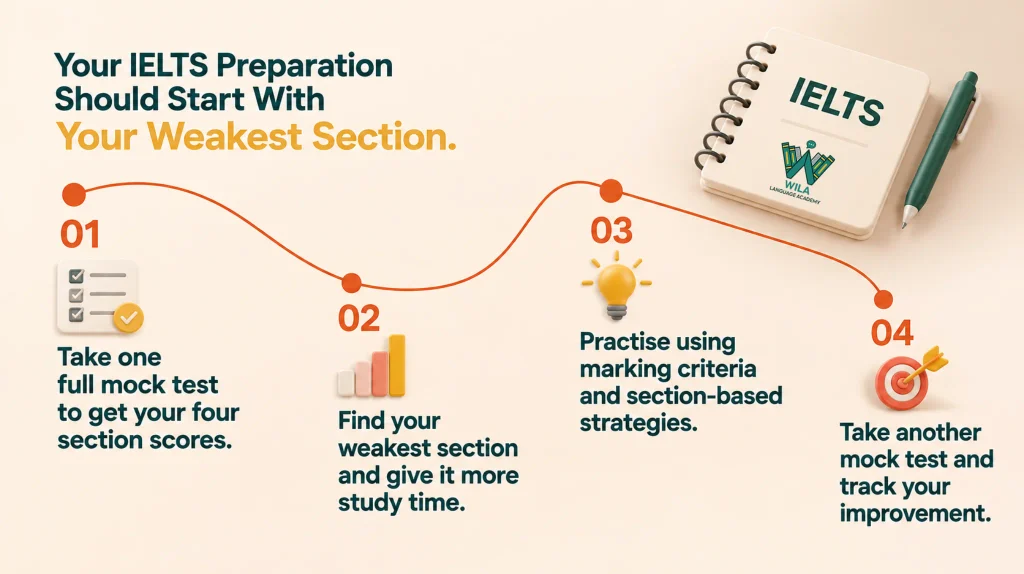
Sit one complete, timed practice test before you open a grammar book. You need four numbers, not a feeling.
The British Council’s IELTS Ready package is free and includes two full mock tests with model answers, short courses and live webinars. IELTS also publishes free sample test questions for both test types. That is enough for a baseline without paying anyone.
First, pick the right test. IELTS General Training is for migrating to a country such as Australia, Canada, New Zealand or the UK, or training and studying below degree level. IELTS Academic is for degree-level study (IELTS). Listening and Speaking are the same in both. Reading and Writing are not, so practicing the wrong version costs you a month.
IELTS Preparation Tips for Listening, Reading, Writing and Speaking
These are the IELTS preparation tips that move your four numbers. Work on your weakest section first and give it more study time than the other three combined.
How do you prepare for IELTS Listening?
You hear the recording once. Listening has four parts, two monologues and two conversations, with 40 questions in about 30 minutes (British Council).
- Answers come in the order the recording gives them. If you miss one, let it go. Hunting for a lost answer is how people lose the next three.
- Use the gaps to read ahead, so you know what you are waiting for: a name, a number, a date, a place.
- Practice with a range of accents, not only the one you are used to hearing.
- You write or type your answers, so check spelling as you go.
How do you prepare for IELTS Reading?
Reading is a time problem before it is a vocabulary problem. You get 60 minutes for 40 questions, roughly 90 seconds each including reading time (British Council). Academic Reading gives you three long passages. General Training gives you five or six shorter everyday texts such as notices, advertisements and work documents.
Do not read the whole passage first. Read the question, work out what you are looking for, then scan for it. And expect the passage to say the same thing in different words, because the answer is rarely sitting there in the wording of the question. Training that swap in wording beats any speed-reading habit.
How do you prepare for IELTS Writing?
Writing is where beginners lose marks without knowing why, so start with the marking, not with essays.
The clock is split for you. Task 1 gets about 20 minutes and at least 150 words. Task 2 gets about 40 minutes and at least 250 words. Task 1 is worth one third of your Writing mark and Task 2 is worth two thirds (IELTS). If you spend half your hour on Task 1, you have put your time in the cheaper half.
Examiners mark Writing on four things: task achievement or task response, coherence and cohesion, lexical resource, and grammatical range and accuracy (IELTS). IELTS publishes the full band descriptors as a free PDF on its Writing resources page. Read them once, properly. They spell out what a band 6 answer does and what a band 7 answer does differently, which is the one document most people never open.
Then three habits:
- Learn what 250 of your own words looks like, handwritten and typed. Coming in under the minimum is an avoidable loss.
- Know which Task 1 you are sitting. Academic asks you to describe a graph, chart, table, process, map or plan. General Training asks you to write a letter.
- Get one Task 2 essay properly marked instead of writing ten nobody reads. Unmarked practice mostly repeats your existing mistakes.
How do you prepare for IELTS Speaking?
Speaking runs 11 to 14 minutes in three parts. Part 1 is four to five minutes on familiar topics like home, work or interests. Part 2 gives you a topic card, one minute to make notes, then one to two minutes to talk. Part 3 is four to five minutes of deeper discussion on that topic (British Council).
It is marked on fluency and coherence, lexical resource, grammatical range and accuracy, and pronunciation, all four weighted equally (IELTS). Pronunciation being one of four means an Indian accent is not a problem. Being hard to follow is.
Part 2 is the part you can genuinely rehearse, so practice the one minute of note-making, not only the talking. And answer in more than a line, because a bare “yes, I do” gives the examiner nothing to score. Add the reason or the example.
Record yourself once a week. Most people find they are not slow, they are hesitant, and those need different fixes.
How long should a beginner prepare for IELTS?
No set of IELTS preparation tips can tell you how many weeks you need, and anyone answering that without asking your current level is guessing. Take the mock test, count the half bands between your weakest section and the score you need, then plan backwards from your application deadline.
Two facts help you time the booking. Results arrive in one to five days for computer-delivered IELTS and up to 13 days for paper (IELTS), and your result stays valid for two years (British Council).
There is also a safety net. One Skill Retake lets you redo a single section instead of the whole test, once per original test, if your full test was on computer at a centre offering it, and booked and taken within 60 days of the original (IELTS). It is available in India. Confirm with your centre before counting on it.
Common mistakes to avoid in your IELTS preparation
The IELTS preparation tips above are worth little if you are also doing these, and they are all versions of practising something other than the test.
- Studying general English for months instead of the four sections and their question types.
- Doing practice tests untimed, which hides the only problem Reading really has.
- Preparing for Academic when you need General Training, or the reverse.
- Writing essay after essay with nobody marking them.
- Avoiding the section you dislike, which is almost always the one costing you the most.
Do you need IELTS coaching, or can you prepare on your own?
You can prepare alone if you can mark your own Listening and Reading and get honest feedback on your Writing and Speaking. If you cannot do the second part, IELTS coaching is not buying you information. It is buying you a marker.
Free IELTS preparation tips and official material already cover the information: sample tests, band descriptors, the format, the standard. What they cannot give you is a person reading your Task 2 and explaining why it is a 6 and not a 7, or sitting through Part 3 with you.
Also separate live IELTS classes from self-paced apps and recorded video courses. A recorded course gives you explanation. Live classes give you correction and a schedule you have to show up for. Choose based on which of those you are missing.
How WILA Languages IELTS classes can help
If your mock test showed Writing and Speaking as the weak half, that is a feedback problem, and self-study handles it worst.
WILA Languages runs live, instructor-led IELTS preparation classes across all four sections, with trainers who mark your writing against the criteria examiners use and give you spoken practice in real time. Teaching is available in English and several Indian languages. If you are still comparing English tests, there is also PTE and TOEFL preparation.
No course can promise a band score. What classes do is make sure you are practicing the right things, and that you hear about your mistakes before test day rather than after.
FAQs
1.What are the best IELTS preparation tips for someone whose English is still basic?
Build the language and the test skill together, but expect the language to take longer. Technique can lift a score by around a band. It cannot replace the vocabulary and grammar range the higher bands are marked on. If everyday conversation is still hard, spend the first stretch on general English and start test-specific practice once you can follow a normal conversation comfortably.
2.Is there a pass or fail in IELTS?
No. IELTS has no pass mark. You get a band from 0 to 9 for each section and an overall band, and the organization you apply to decides what it accepts (IELTS).
3. How many times can I take IELTS?
There is no limit on sitting the full test again. One Skill Retake is the restricted one: once per original test, within 60 days, computer-delivered only (IELTS).
4. Is computer-delivered IELTS easier than paper-based IELTS?
Neither is easier. The content, question types and scoring are the same. The differences are speed of results, whether you type or handwrite, and that One Skill Retake needs a computer-delivered test. Choose based on whether you type or write faster under pressure.
5. How does an IELTS band compare to a CEFR level?
IELTS bands and CEFR levels describe the same skills on different scales and are not interchangeable, so check which one your university, employer or visa route asks for. If the A1 to C2 scale is new to you, our guide to CEFR language levels explains what each level lets you do.







