
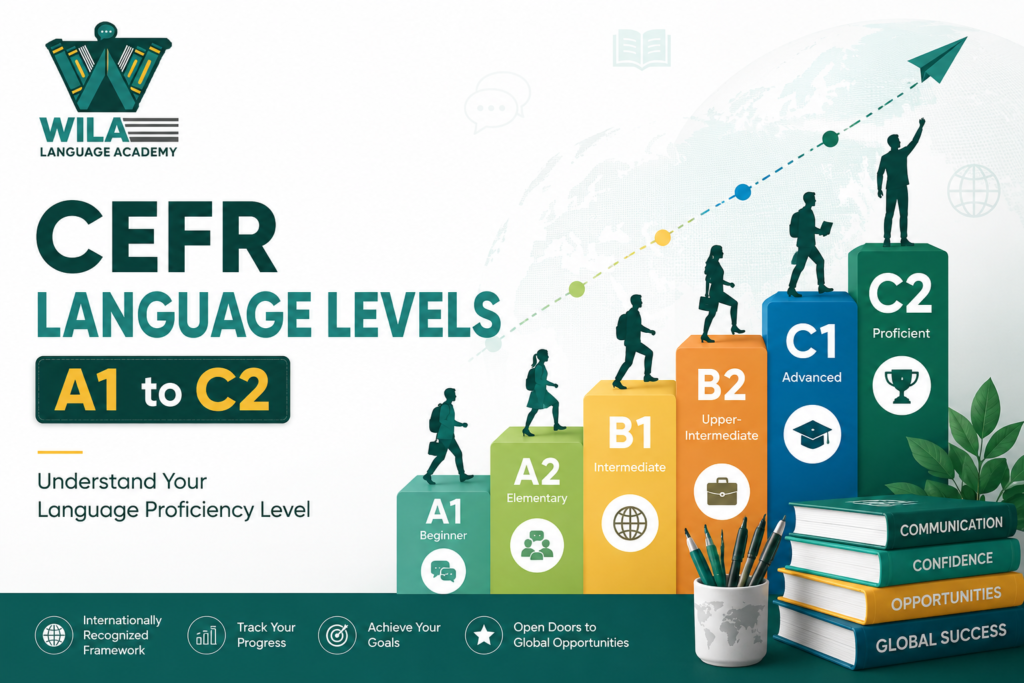

CEFR language levels help you understand how well you can communicate in a language, from beginner A1 to proficient C2. You have probably seen a level such as A2, B1, B2, or C1 listed next to a university application, a job posting, or a visa route, and wondered what it actually means and which one you need.
What Is CEFR actually?
CEFR is a common scale for describing how well someone can use a language. The letters stand for the Common European Framework of Reference for Languages, developed by the Council of Europe. This CEFR framework sorts proficiency into six levels, A1 to C2, and describes each one through what a learner can actually do, using plain “can-do” statements rather than a grammar or vocabulary checklist. In other words, it turns broad ideas about ability into defined language proficiency levels that everyone can read the same way.
Universities, employers, language schools, teachers, and exam providers all use CEFR so that a level means the same thing to everyone. Despite the word European in the name, the framework is not limited to European languages. It is applied to English, German, French, Spanish, and many others, which is why you see the same A1, B1, or B2 labels across different languages. The level tells you the proficiency band; the vocabulary, grammar, and pronunciation change from one language to the next.
Three things CEFR is not: it is not a test you sit, it is not a certificate you hold, and it is not a course that teaches you. It is the ruler, not the exam and not the proof. Keep that distinction in mind, because most reader confusion comes from mixing these three up. We come back to it in detail later.
How the CEFR System Works
The six CEFR proficiency levels group into three broad bands, and understanding the bands is more useful than memorizing the letters.
| Band | Levels | What it means in one line |
| Basic User | A1, A2 | You can handle simple, familiar, everyday situations. |
| Independent User | B1, B2 | You can function on your own in most real situations, up to complex ones at B2. |
| Proficient User | C1, C2 | You can operate with precision and ease in demanding academic and professional settings. |
CEFR Levels Explained: A1 to C2
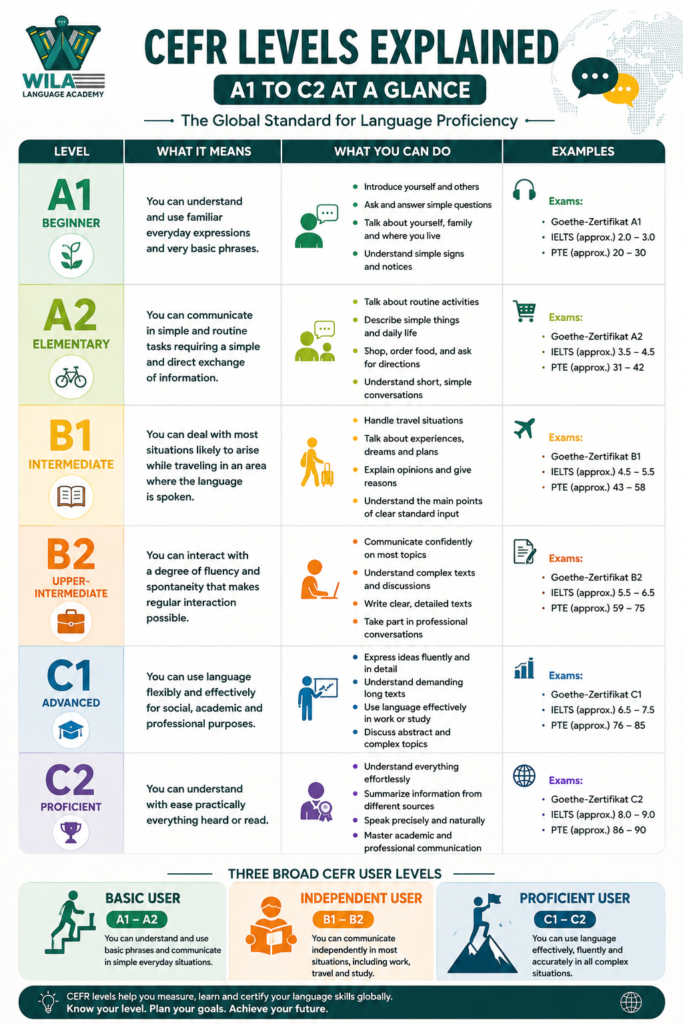
Each of the CEFR proficiency levels below answers three questions in order: what you can do, what you cannot reliably do yet, and who typically needs this level.
A1 – Breakthrough (Beginner)
A1 is where you start from scratch. You can introduce yourself, ask and answer simple questions, order food, ask for directions, and handle basic transactions, as long as the other person speaks slowly and helps you along.
Who needs it: Travellers, and anyone at the very start of a longer plan. A1 also appears in some entry-level routes: Switzerland requires A1 in specific family-reunification cases, and Germany’s Opportunity Card accepts A1 German (or B2 English) as one of its basic requirements.
What you cannot reliably do yet: Hold a real conversation, follow normal-speed speech, or manage anything unexpected. You lean heavily on memorized phrases.
A2 – Waystage (Elementary)
A2 is where you stop merely surviving and start managing familiar everyday life. You can talk about work and family, describe past experiences in simple terms, make routine appointments, and understand common announcements, building your own sentences instead of only reciting phrases.
Who needs it: Vocational and integration pathways where basic everyday language is expected. Germany’s Recognition Partnership route for nurses, introduced in 2024, can let candidates enter with A2 German and finish qualification recognition while working.
What you cannot reliably do yet: Handle unfamiliar or abstract topics, follow fast group conversation, or study and work in the language.
B1 – Threshold (Intermediate)
B1 is the first big jump: from surviving to functioning independently. You can explain a problem, describe experiences and plans, give reasons for an opinion, handle most situations that come up while travelling, and understand the main points of clear, standard speech.
Who needs it: Many entry-level and vocational roles, and some visa routes. In Germany, B1 is commonly accepted to enter as a nursing assistant and for many non-healthcare apprenticeships, though it is rarely enough for university or a fully regulated profession on its own.
What you cannot reliably do yet: Follow complex or fast discussion, argue a detailed case, or keep up with academic or specialist material.
B2 – Vantage (Upper-Intermediate)
B2 is where communication becomes genuinely flexible. You can follow the main ideas of complex texts, take part in longer discussions, hold your own with proficient speakers, and explain and defend a viewpoint across a range of subjects.
Who needs it: Most skilled professional work and many degree programmes. For example, full registration as a nurse in Germany generally requires B2 German, and regulated or communication-heavy roles usually expect B2 or a profession-specific language qualification.
What you cannot reliably do yet: Handle highly specialized language with full precision, or catch every nuance, accent, and piece of slang.
C1 – Effective Operational Proficiency (Advanced)
At C1 the focus shifts from getting your point across to doing it with precision, flexibility, and control. You can understand long, demanding texts, catch implied meaning, speak fluently with little hesitation, and adjust your language to the situation, whether a professional meeting, formal writing, or a complex explanation.
Who needs it: Advanced academic study and specialized careers. As an example, most German-taught university degrees require C1-level German (through exams such as TestDaF or DSH), and some language-intensive fields ask for even more.
What you cannot reliably do yet: This is genuinely strong ability; the remaining gap to C2 is about full nuance and effortless range, not everyday function.
C2 – Mastery (Proficient)
C2 is the top of the scale. You can understand almost everything you hear or read, express fine shades of meaning, pull information together from different sources, and adapt your language naturally. This is the closest CEFR comes to describing complete language fluency. Note what C2 is not: it is not a certificate of being a native speaker. It describes what you can do with the language, and plenty of highly capable users never sit a C2 exam because they do not need to.
Who needs it: Language-dependent careers such as translation, interpretation, language teaching, and research, plus a few especially demanding academic or professional routes. For most study, work, or migration goals, C2 is more than you need.
How Levels Change From A1 to C2
Rather than reading the six CEFR proficiency levels as separate definitions, it helps to see what actually changes at each jump. The shift is not just “more words.” It is a change in what you can do.
| The jump | What really changes |
| A1 to A2 | From basic phrases to managing familiar everyday situations on your own. |
| A2 to B1 | From surviving to functioning independently: explaining, describing, giving reasons. |
| B1 to B2 | From handling everyday life to handling complexity, which is why B1 is rarely enough for university or skilled work. |
| B2 to C1 | Not more words, but more precision, speed, flexibility, and control of register. |
| C1 to C2 | Full nuance and effortless range, the difference between very strong and near-complete. |
The same progression across the five things you actually do with a language:
- Vocabulary: basic words, then a wider range, then precise and nuanced vocabulary.
- Grammar: simple patterns, then connected sentences, then complex structures used with control.
- Listening: slow, simple speech, then normal conversation, then complex speech and implied meaning.
- Speaking: short answers, then connected speech, then structured, flexible communication.
- Writing: simple messages, then connected text, then detailed, well-structured writing.
What Level Do You Actually Need for Your Goal?
This is the section most people are really searching for. One rule first, because it prevents expensive mistakes: the CEFR proficiency levels you need are set by a specific country, institution, profession, or visa route, not by CEFR itself. Let’s understand which roles fit your goals.
If You Want to Study Abroad
Among all the CEFR proficiency levels, the one you need to study abroad depends heavily on the language of instruction. For programmes taught in the local language, expectations are high. In Germany, for example, most German-taught degrees require B2 or higher, with many programmes expecting C1 (proven through TestDaF or DSH), and language-intensive fields such as medicine asking for more. For English-taught programmes, local-language proof is usually not needed for admission, although some still expect a basic A1 or A2 certificate during the course for daily life.
Separate two questions that are easy to blur: “Can I get admitted?” and “Can I comfortably study in this language?” Meeting the minimum on paper is not the same as following fast lectures and writing assessed essays without strain.
If You Want to Work Abroad
There is no single “level for a job.” It depends on the industry, the role, the country, how much you deal with customers, and whether the profession is regulated. In Germany, many general skilled and apprenticeship roles in fields like IT or logistics commonly accept B1, with employers supporting further learning on the job.
Regulated and communication-heavy professions expect more: full nursing registration in Germany generally needs B2 plus a specialist language exam. A back-office technical role, a nurse, and a customer-facing salesperson can face very different language demands even in the same country.
If You Want to Migrate
Here is the trap: a CEFR level and an immigration requirement are not automatically the same thing, and not every country measures against CEFR at all. Canada is the clearest example. Its Express Entry system scores French and English on its own scales, NCLC and CLB, not CEFR.
Reaching NCLC 7 in all four French skills, which maps roughly to CEFR B2, can unlock up to 50 additional points in the Comprehensive Ranking System and access to French-language draws with lower cut-offs (the point structure and thresholds are set by IRCC). The lesson generalizes: check the exact framework, level, and test your destination’s authority uses, because “B1 is a CEFR level” never means “B1 is accepted for every immigration purpose everywhere.”
If You Just Want Everyday Life to Work
Your required level depends on what you need to do, not simply where you go. As a rough guide: A1 covers survival situations, A2 handles many routine ones, B1 gives real independence, B2 lets you take part in demanding social and professional situations, and C1 and above let you operate with ease in complex settings.
Frequently Asked Questions
What is CEFR, and is it an exam or certificate?
CEFR is neither an exam nor a certificate. The Common European Framework of Reference for Languages (CEFR) is a CEFR framework that describes language proficiency from A1 to C2. A language exam measures your ability, while a certificate proves your result. In simple terms: CEFR defines the level, the exam measures it, and the certificate provides proof.
What are the CEFR levels, and what is the highest level?
There are six CEFR proficiency levels: A1, A2, B1, B2, C1, and C2. A1 is beginner-level ability, while represents very high proficiency. C2 is the highest CEFR level, but it does not mean you are a native speaker.
A1- Basic Communication
A2 – Routine everyday communication
B1 – Independent communication
B2 – Confident communication in complex situations
C1 – Advanced academic and professional use
C2 – Very high, precise and flexible language use
Is B2 considered fluent, and do I have the same CEFR level in every skill?
B2 is a strong and independent level, but “fluent” is not a precise CEFR term. A B2 learner can still make mistakes, struggle with slang, or lack specialist vocabulary.
You can also have different levels across listening, reading, speaking, and writing. For example, you may be B2 in listening but B1 in writing. This matters because some universities, employers, exams, and immigration authorities require a minimum level in each skill, not just an overall score.
What CEFR level do I need to study, work, or live abroad?
There is no single CEFR level for everyone. The CEFR proficiency levels you should target depend on your country, institution, profession, visa, and purpose.
Master A1 & A2 for basic travel and daily interaction, B1 for greater independence abroad, B1 to B2 for professional work, B2 to C1 for studying in the target language, & C1-C2 for complex academic/professional communication.
These are general guidelines, not universal admission, employment, or visa requirements. Always check the exact requirement of the university, employer, professional body, or immigration authority.
Is CEFR accepted for visas and immigration applications?
Sometimes, but not universally. Some countries and immigration pathways accept language exams that report results against CEFR, while others use their own systems. For example, Canada uses Canadian Language Benchmarks (CLB) and Niveaux de compétence linguistique canadiens (NCLC) for many immigration purposes.
A CEFR level or language certificate does not guarantee visa approval. Check which exam, score, and language level the specific immigration authority accepts for your visa or migration pathway.
What is the difference between a CEFR level, language exam, and certificate?
They serve different purposes:
CEFR defines the proficiency level. The exam tests your language skills. The certificate proves your exam result.
For example, Goethe-Zertifikat B1 is a German exam designed to assess B1-level proficiency. CEFR B1 is the level being assessed; the Goethe exam is the assessment; the certificate is the proof. This is how language certification connects back to a CEFR level: the certificate is proof of the level, not the level itself.
IELTS, TOEFL, PTE, Cambridge English, Goethe-Zertifikat, telc, TestDaF, DELF, DALF, TCF, DELE, and SIELE are examples of language exams whose results can be related to CEFR levels. Their formats, scoring systems, and purposes are different.
Can I convert my IELTS, TOEFL, Goethe, or other exam score into a CEFR level?
There is no single CEFR conversion table that works for every exam. Each exam has its own scoring system and may publish its own CEFR mapping.
For example, an IELTS band score and a Goethe exam score cannot be directly compared as numbers, even if both results correspond to a similar CEFR level.
Use the official score-to-CEFR mapping from the exam provider and check whether the university, employer, or authority accepts that particular exam.
How long does it take to reach B1, B2, or another CEFR level?
There is no fixed number of hours required to reach a CEFR level. Your progress depends on your starting level, the language you are learning, previous language experience, study hours, quality of practice, exposure, speaking opportunities, and consistency.
Common planning estimates suggest that cumulative guided learning may increase roughly like this – A1 (60-100hrs), A2 (60-100hrs), B1 (80-120 hrs), B2 (80-120 hrs), C1 (100-140 hrs), C2 (100-140hrs)
These are directional estimates, not official CEFR requirements or guarantees. Actual learning time varies significantly between learners and languages.
Can I skip a CEFR level, and do I need a certificate for every level?
You do not have to take every CEFR exam in sequence. If you already have B1 ability, you can take a B1 exam without holding A1 or A2 certificates.
However, you cannot skip the ability required for that level. You still need to demonstrate B1 proficiency to pass a B1 exam.
You also do not need a certificate for every level unless a university, employer, immigration authority, or professional body specifically asks for one. Having B1 ability and having an accepted B1 certificate are two different things.
How can I find my current CEFR level?
You can estimate where you sit on the CEFR proficiency levels in three ways:
Self-assessment: Compare your listening, reading, speaking, and writing ability with CEFR “can-do” statements.
Placement test: Take a structured language assessment from a language school or provider.
Recognized language exam: Take an official exam when you need formal proof of your CEFR level.
A grammar quiz alone is not enough to establish your CEFR level. Real proficiency covers multiple skills and your ability to actually use the language in different situations.
Conclusion
CEFR turns language ability into a clear path, from A1 to C2. By setting out proficiency as defined language proficiency levels, it helps you understand what you can do now, what level you need for your goal, and what to work towards next.
Your position on the CEFR proficiency levels is not fixed. With consistent learning and practice, you can move from basic communication to advanced proficiency.
At WILA Languages, build your language skills through structured, instructor-led German, French, and Spanish courses from A1 to C2, plus IELTS, PTE, and TOEFL preparation. Start where you are and work towards the level your next opportunity requires.
Please Note
WILA Languages is a private language-training provider. It is not an authorized examination centre for the Goethe-Institut, DELF/DALF, or DELE/SIELE. The exams named in this article are administered by their respective official bodies. Course completion prepares you for these exams but does not constitute registration for or certification by any of them.
Find Your Level, Then Close the Gap
Book a level assessment and start structured training in German, French, or Spanish, or English exam preparation, taught online.







