

If you have started learning German, you will quickly come across two levels: A1 and A2. Both are beginner levels, but they do not feel the same when you actually start using the language.
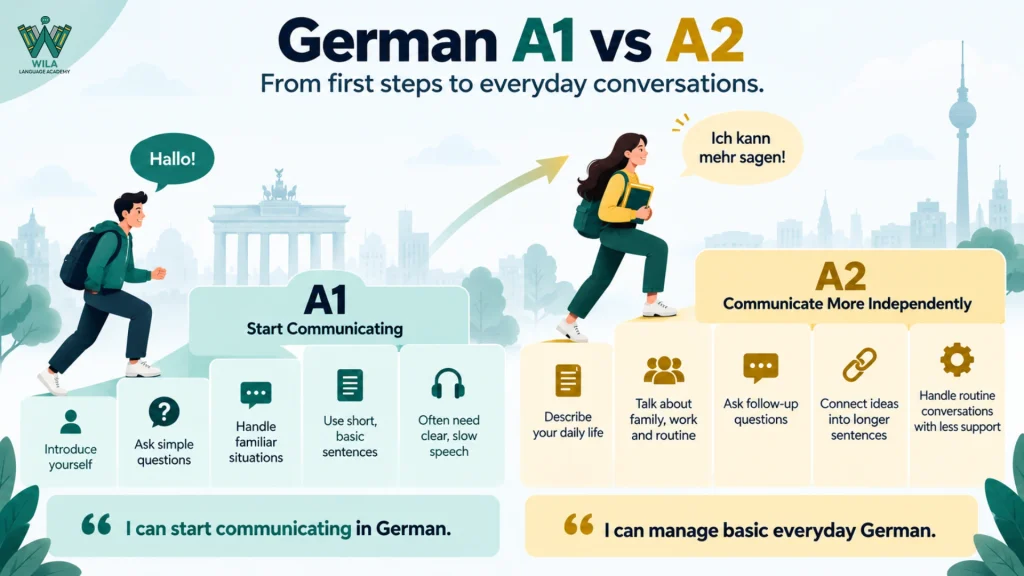
At A1, you are learning to manage basic communication. You can introduce yourself, ask simple questions and deal with familiar situations. At A2, you start using German with more freedom. You can describe your daily life, talk about familiar topics and manage more routine conversations.
That is the real difference between German A1 vs A2. It is not simply about learning more German Grammar or German Vocabulary. It is about what you can do with the German you know.
German A1 vs A2 at a Glance
A1 and A2 are both part of the basic user category in the Common European Framework of Reference for Languages, or CEFR. At A1, learners can use familiar expressions, introduce themselves and communicate in simple situations when the other person speaks clearly. At A2, learners can handle simple and routine exchanges about familiar topics.
| Area | German A1 | German A2 |
|---|---|---|
| Communication | Start communicating with short phrases in familiar situations; often need clear, slow speech and some support. | Handle short conversations about familiar topics with more connected responses and less support. |
| Skills | Understand simple signs and messages, write basic sentences and talk about personal information and immediate needs. | Understand short everyday texts and routine conversations, write connected messages and talk about family, work, shopping and daily life. |
| Overall | “I can start communicating in German.” | “I can manage basic everyday German.” |
If you want to see how A1 and A2 fit into the complete German proficiency path, read our German Language Levels A1 to C2 guide.
German A1 vs A2: The Difference in Real-Life Situations
A1 helps you manage simple, predictable exchanges. You can introduce yourself, ask basic questions and handle familiar situations when the other person speaks clearly. A2 gives you more control in those same situations. You can add details, connect ideas, ask follow-up questions and manage routine conversations with less support.
| Situation | A1: Basic communication | A2: More independent communication |
|---|---|---|
| At a restaurant | Ich möchte einen Kaffee und ein Sandwich, bitte. (I would like a coffee and a sandwich, please.) | Haben Sie auch vegetarische Sandwiches? Was empfehlen Sie? (Do you also have vegetarian sandwiches? What do you recommend?) |
| At a shop | Wie viel kostet das? (How much does that cost?) | Haben Sie das auch in einer anderen Größe? Gibt es dieses Modell auch in Schwarz? (Do you also have that in another size? Is this model also available in black?) |
| Meeting someone | Ich heiße Priya. Ich komme aus Indien. Ich wohne in Hamburg. (My name is Priya. I come from India. I live in Hamburg.) | Ich komme aus Indien, aber ich wohne seit einem Jahr in Hamburg. Ich arbeite hier als Ingenieurin und lerne Deutsch, weil ich langfristig in Deutschland arbeiten möchte. (I come from India, but I have lived in Hamburg for a year. I work here as an engineer and am learning German because I would like to work in Germany long term.) |
| Talking about your day | Ich arbeite heute. Ich bin müde. Ich gehe nach Hause. (I am working today. I am tired. I am going home.) | Heute habe ich viel gearbeitet. Ich bin ziemlich müde, deshalb gehe ich nach der Arbeit direkt nach Hause. (I worked a lot today. I am quite tired, so I am going straight home after work.) |
The situation stays the same, but your ability to handle it improves.
At A2, you can give more information, ask follow-up questions and connect ideas instead of relying only on short, separate sentences. This is why the move from A1 to A2 can feel like a bigger change than simply learning another set of German Vocabulary.
Why Does A2 German Feel Harder Than A1?
This is one of the most common questions learners ask when comparing German A1 vs A2.
A2 feels harder because you move beyond short, familiar sentences. You need to understand more everyday variations and express your own ideas instead of repeating memorized phrases.
As your German improves, German Grammar becomes a tool for saying more. Depending on the course, A2 learners may work with:
- German cases
- modal and separable verbs
- common past forms
- conjunctions and connectors
- longer sentence structures
- more complex word order
- common prepositions
The exact syllabus varies by course, but the goal is the same: use grammar to communicate more clearly, not just complete exercises.
This is also why some learners feel that A2 is the point where Beginner German starts to become more useful in everyday conversations.
Is A2 Just More Vocabulary Than A1?
This question comes up often when people look at German A1 vs A2 side by side.
No. Knowing more German Vocabulary does not automatically mean you are at A2. The key difference is how well you use familiar words to communicate complete thoughts.
At A1, you might know words such as:
- Arbeit, Familie, Wohnung, Essen, Bus, Bahnhof
At A2, you can combine familiar vocabulary into connected sentences:
- Ich fahre jeden Morgen mit dem Bus zur Arbeit. Wenn der Bus zu spät kommt, nehme ich manchmal die U-Bahn.
The move from A1 to A2 is not just about learning more words. It is about using vocabulary, grammar and sentence patterns more independently.
Should You Take a German A1 Course or A2 Course?
The right course depends on your current ability, not simply on how many German words you recognize. Use this German A1 vs A2 breakdown to see which course matches where you are right now.
| Choose a German A1 Course if you… | Choose a German A2 Course if you… |
|---|---|
| Have never studied German. | Have already completed A1. |
| Recognize a few words but cannot form basic sentences. | Can introduce yourself without memorizing every sentence. |
| Struggle to understand simple questions. | Understand common questions about familiar topics. |
| Depend heavily on translation. | Can talk about your family, work or daily routine. |
| Can introduce yourself only through memorized sentences. | Can understand short German messages. |
| Are still learning basic German Grammar. | Can form simple sentences without translating every word. |
| Cannot comfortably describe your family, work or daily routine. | Can handle basic conversations without being given the exact words. |
If you are between the two levels, a placement test is better than guessing.
The Goethe-Institut also recommends a placement test as an initial way to identify the appropriate level, followed by a more detailed assessment when needed for course or exam registration.
Can You Skip German A1 and Start at A2?
Yes, if you already have A1-level knowledge. You do not need to take a German A1 Course simply because A1 comes before A2. If you can already handle basic conversations, understand common questions and describe familiar topics, a German A2 Course may be the better starting point.
However, knowing a few German phrases is not enough for A2.
The important question is not:
- “Have I completed an A1 course?”
It is:
- “Can I use German at an A1 level?”
What if you need an A1 certificate?
The Goethe-Institut offers the Goethe-Zertifikat A1 and Goethe-Zertifikat A2, both of which assess basic German language skills at their respective CEFR levels. Some organizations may require proof of a particular level for a specific purpose.
If you need German for a visa, university application, professional recognition or another formal process, check the current requirement of the organization involved before choosing an exam.
A Quick Test: Are You Ready for A2 German?
Use this quick check as a practical way to test yourself on German A1 vs A2 before choosing a course.
Ask yourself whether you can do the following without depending heavily on a script.
Speaking
- Can you introduce yourself naturally?
- Describe your family?
- Talk about your daily routine?
- Explain what you do at work or school?
- Talk about your likes and dislikes?
- Describe a simple past experience?
- Ask and answer basic follow-up questions?
Listening
- Can you understand slow, clear conversations about familiar topics?
- Follow simple instructions?
- Understand the main information in a short everyday conversation?
Reading
- Can you understand a short message?
- Understand common signs and notices?
- Find basic information in an everyday text?
Writing
- Can you write a short message about your plans?
- Describe your routine?
- Write a few connected sentences about yourself?
What Your Result Means
| Your result | What it means |
|---|---|
| You can do very few of these tasks. | A1 is probably the better starting point. |
| You can do some but not most of these tasks. | You may be between A1 and A2. A placement test can help you decide. |
| You can do most of these tasks. | You are likely ready to study at A2. |
This is not an official CEFR assessment. It is a practical way to think about your current ability before choosing a course.
Common Problems When Moving From A1 to A2
Moving from A1 to A2 can feel difficult. You may understand basic German but struggle to use it quickly.
- You know the word but cannot use it
Recognizing a word is easier than remembering it during a conversation.
Try to:
- Learn vocabulary in short, useful sentences.
- Practice each word in different everyday situations.
- Review new words regularly instead of memorizing them once.
- Use new vocabulary in short speaking or writing exercises.
- You know the grammar but forget it while speaking
You may understand a German Grammar rule in an exercise but struggle to use it naturally.
Try to:
- Practice the same structure in short conversations.
- Create simple examples about your daily life.
- Repeat the structure aloud until it feels more familiar.
- Focus on using the grammar clearly rather than speaking perfectly.
- Longer sentences become confusing
As you connect ideas, German word order becomes more important.
Try to:
- Learn common sentence patterns.
- Start with short sentences and connect them gradually.
- Change one part of a sentence at a time.
- Practise conjunctions and connectors in familiar contexts.
- Read short German texts to notice how sentences are structured.
- You translate everything
Translating every sentence can slow down communication.
Try to:
- Learn common German expressions as complete phrases.
- Use pictures, examples or context to understand new words.
- Practice responding to simple questions without translating first.
- Focus on understanding the main meaning rather than every individual word.
- Gradually reduce your dependence on translation.
How Long Does It Take to Go From A1 to A2 German?
The timeline varies depending on your study schedule, learning pace and opportunities to practice. Generally, learners may need around 150 to 260 hours of guided learning to reach A2, although some progress faster or slower. You may be ready to move on from A1 when you can introduce yourself, understand basic questions, describe familiar topics and manage simple everyday exchanges.
Do You Need A1 or A2 German for Germany?
The German level you need depends on your university programme, employer, profession, visa or residence pathway, and the organization requesting proof of German. The Goethe-Institut offers recognised German examinations from A1 to C2, but requirements vary by situation, so check the current language requirement for your specific purpose before choosing an exam.
German A1 vs A2: Which One Should You Choose?
Choose based on what you can already do.
| If this sounds like you… | Choose |
|---|---|
| You are new to German or cannot form basic sentences. | German A1 Course |
| You studied A1 but have forgotten much of it. | A1 revision or placement test |
| You can introduce yourself and answer basic questions. | Consider A2 after assessment |
| You can discuss your family, work and routine. | German A2 Course |
| You are unsure of your level. | Take a placement test |
| You need German for a formal application. | Check the required level first |
In short, A1 helps you start communicating, while A2 helps you manage familiar everyday situations more independently.
Start with A1 if you are still building basic sentences and understanding familiar expressions. Choose A2 if you can already describe your life, understand basic German and handle routine conversations.
For the full progression from A1 to C2, see our German Language Levels A1 to C2 guide.
Turn Your German Level Into Real Progress With WILA Language
Knowing whether you are at A1 or A2 gives you a starting point, but progress comes from having the right support between lessons. You need opportunities to speak, feedback on your mistakes and a clear path that helps you move from recognizing German to using it with confidence.
WILA Language offers live, instructor-led German A1 and A2 Courses for learners who want structured guidance and practical communication skills. The courses combine speaking, listening, reading, writing, German Grammar and German Vocabulary with regular assessment and preparation for the Goethe-Zertifikat exams.
The German A1 Course is suitable if you are beginning German from scratch. The German A2 Course is designed for learners who already understand the basics and want to communicate more comfortably in everyday situations. If you are unsure where to begin, a placement assessment can help you choose the course that matches your current ability.
FAQs on German A1 vs A2
1.What is the difference between German A1 and A2 grammar?
A1 introduces the basic grammar needed to form simple sentences and communicate in familiar situations. At A2, learners generally use a wider range of grammar to connect ideas, describe situations, talk about past events and communicate more clearly in everyday German.
2. Is A2 enough for Germany?
There is no single German level that is enough for every purpose in Germany. The required level depends on your university, employer, profession, visa or residence pathway. Always check the current language requirement for your specific situation before choosing an exam.
3. What comes after A2 German?
B1 comes after A2. At B1, learners move towards more independent communication and can deal with a wider range of familiar situations. If you want to understand the complete progression, our German Language Levels A1 to C2 guide covers the journey from A1 through C2.







