

You have probably been studying Spanish the way you like to study it. Reading. Grammar exercises. New words in a notebook. That is good work and none of it is wasted. But it builds two of the four skills the DELE tests, and the exam will not let you trade one for another.
Here is the part that catches people out. The DELE puts your four skills into two groups. Reading and writing go in one. Listening and speaking go in the other. You have to pass both groups separately. So you could score 45 out of 50 on reading and writing, get 28 out of 50 on listening and speaking, and walk out with 73 marks out of 100. And still fail. Once you know that, the rest of your DELE exam preparation gets easier.
What is the DELE exam?
The DELE is an official Spanish language certificate. Instituto Cervantes runs it for Spain’s Ministry of Education, and it covers six levels, from A1 for complete beginners up to C2 for near-native speakers.
It never expires. Pass DELE B2 in 2027 and you still hold DELE B2 in 2040. And it is the same exam everywhere, because the papers are set centrally in Spain, so a DELE B2 taken in Mumbai means what a DELE B2 taken in Madrid means.
Before anything else, find out which level you actually need. Ask the university, the employer or whoever is asking you for it. The certificate covers only the level you sat, so if you need B2 and you pass B1, you sit the whole thing again, and months of DELE exam preparation go with it.
How is the DELE exam scored?
Your four papers go into two groups, each worth 50 marks. You need 30 in each group.
| Group | What is in it | You need |
|---|---|---|
| Group 1 | Reading + Writing | 30 out of 50 |
| Group | What is in it | You need |
|---|---|---|
| Group 2 | Listening + Speaking | 30 out of 50 |
Instituto Cervantes states it directly: you need a pass in both groups. Not a good average across them.
Picture two people sitting the same B2 exam.
- The first one is steady across all four skills. She gets 40 in Group 1 and 32 in Group 2. That is 72 marks, and she passes.
- The second one reads beautifully but goes quiet the moment someone speaks to her. She gets 45 in Group 1 and 28 in Group 2. That is 73 marks, and she fails.
The second person scored higher. She still goes home without the certificate.
C2 works a little differently, with three papers instead of four and 20 marks needed in each. Either way your result comes back as APTO or NO APTO. Pass or fail, with no percentage and no grade. (Instituto Cervantes)
For most people studying on their own, Group 2 is the weak one. It makes sense when you think about it. You can read a book alone. You can write an essay alone. You cannot have a conversation alone.
How to plan your DELE exam preparation
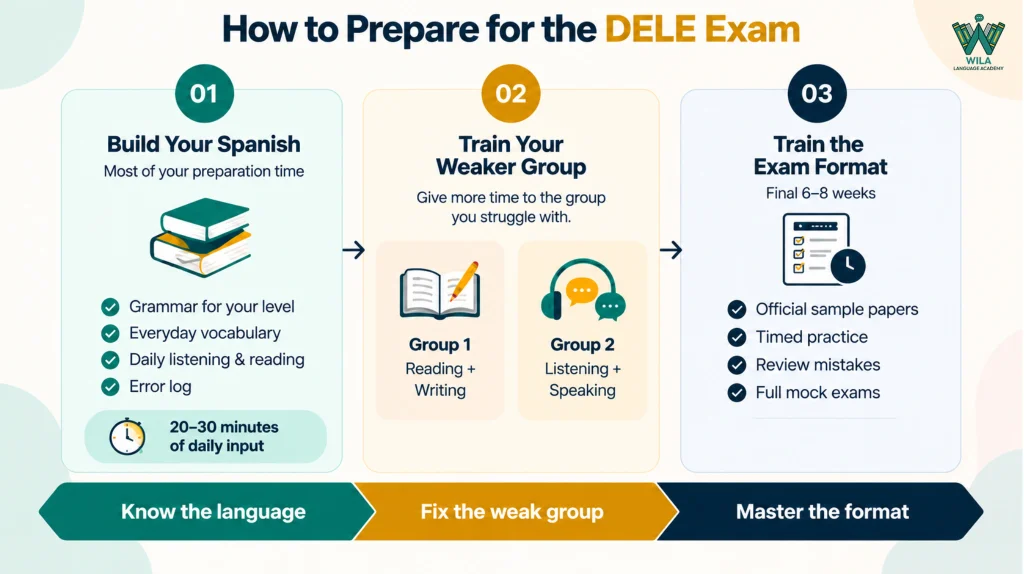
DELE exam preparation runs in three steps. The first takes months, the last takes weeks, and most people spend all their time on the first one.
Step 1: Build your Spanish first
There is no clever exam trick for Spanish you have not learned yet. Give this stage most of your time.
- Learn the grammar for your level, not all of it.
- Build words around real topics: daily life, work, travel, health, food, news, opinions. A hundred connected words beat five hundred random ones.
- Keep a list of your own repeated mistakes, not a list of rules. If the same error shows up three times in a week, that is your next lesson.
- Get a little Spanish into every day. Twenty minutes daily does more than four hours on Sunday. RTVE, Radio Ambulante and BBC Mundo are all free.
You are ready for Step 2 when you can look at a practice question, get it wrong, and understand why.
Step 2: Fix your weaker group
Be honest about which group is weaker, then give it more time than you want to.
If listening is the problem
- Start with audio that has a transcript. Listen once while reading along, then listen again without it. Drop the transcript as soon as you can manage.
- Do not stop when you miss a word. This is the habit that quietly costs people marks. You miss one word, you panic about it, and while you are panicking the speaker finishes the sentence that would have explained it. Keep listening.
If speaking is the problem
- Record yourself answering a question, then listen back. It is uncomfortable the first few times. It is also the fastest way to hear the mistake you make constantly and never notice.
- Fix one thing at a time. Pick the error you repeat most and work only on that for a week.
- Talk to an actual person. Speaking to yourself builds fluency, but the exam is a conversation, and handling a question you did not expect is a different skill.
If reading and writing are the problem, it is usually speed and length rather than understanding. Practice finishing inside the time, and practice writing to a word count.
Step 3: Learn how the exam works
Save this stage of your DELE exam preparation for the last six to eight weeks. These are the things the official guides explain and most people find out too late.
You write from something, not from nothing. At B1 and B2, both writing tasks give you a short text or a recording to respond to. So writing is partly a reading task. Before you write a word, find the two or three points you are being asked to cover.
The word limits are short. B2 asks for 150 to 180 words. B1 asks for 100 to 120, then 130 to 150. A1 asks for 30 to 40. Writing more earns you nothing. Write out 150 words in your own handwriting once, see how much space it takes, and stop counting during the exam.
You get as much thinking time as speaking time. A1 gives you 10 minutes to prepare for 10 minutes of speaking. B1 gives 15 for 15. B2 and C1 give 20 for 20. Most people waste it writing out sentences. Write down three points instead. A script read aloud always sounds like a script read aloud.
Then do full practice papers, timed, sitting at a table. Use the official sample papers first, because they show you the real wording and the real answer sheets. When you finish one, spend longer on why you got things wrong than on the score.
One thing not to do: do not start your DELE exam preparation by memorizing model answers. It feels productive, and it falls apart the moment the question is worded differently.
What does the DELE exam look like?
Four papers at every level up to C1. As the level goes up, the texts get longer and you are asked to produce more.
| Level | Reading | Listening | Writing | Speaking (+ prep time) |
|---|---|---|---|---|
| A1 | 45 min | 25 min | 25 min | 10 min (+10) |
| A2 | 60 min | 40 min | 45 min | 12 min (+12) |
| B1 | 70 min | 40 min | 60 min | 15 min (+15) |
| B2 | 70 min | 40 min | 80 min | 20 min (+20) |
| C1 | 90 min | 50 min | 80 min | 20 min (+20) |
| C2 | Combined: 105 min (reading and listening) | 150 min | 20 min (+30) |
Source: Instituto Cervantes. C2 is the odd one out, with three papers instead of four. The speaking test is usually held separately, sometimes on a different day, so check that with your centre.
Which level should you take?
If someone has asked you for a specific one, take that. If not, B2 is the level most universities and employers recognize. Either way, sign up for the level you can almost pass today, not the one you want on your CV. Getting it wrong costs you the fee and the session, and the next session offering your level could be six months away.
DELE exam dates, fees and centres in India
Your DELE exam preparation should be well under way before you book a session. When you are ready, check four things together before you pay: your level, the session, the centre and the fee. Not every level runs in every session, and not every centre runs every level.
Registration for the 2027 exams opens on 18 November 2026.
| Exam date | Levels | Last date to register |
|---|---|---|
| 12 February 2027 | A2 | 7 January 2027 |
| 2 April 2027 | A1, A2, B1, B2, C1 | 10 February 2027 |
| 22 May 2027 | A1, A2, B1, B2, C1, C2 | 7 April 2027 |
| 9 July 2027 | A2, B1, B2, C1 | 12 May 2027 |
| 10 September 2027 | A2 | 14 July 2027 |
| 15 October 2027 | A2, B1, B2 | 1 September 2027 |
| 13 November 2027 | A1, A2, B1, B2, C1, C2 | 29 September 2027 |
Source: Instituto Cervantes exam calendar. These are the worldwide dates. Which levels run at an Indian Centre is decided here, so confirm with the centre.
- Fees: For the 2026 exams, Instituto Cervantes New Delhi listed fees from around ₹5,700 for A1 up to about ₹9,000 for C2. Use that as a rough idea only, because fees change every year and centres can charge differently. Check the official fees page before you pay.
- Centres: There is no single exam hall for the whole country. The DELE runs through approved centres in cities including Bengaluru, Jaipur, Kolkata, Mumbai, Mussoorie and New Delhi (current list).
Before You Register, Tick These Off:
- ☐ You know which level you need
- ☐ There is a session that offers your required level
- ☐ An Indian centre near you is conducting that level in the selected session
- ☐ You have checked the exam fee with the centre
- ☐ Your ID documents are ready
- ☐ You have completed registration and payment before the deadline
How WILA Languages can help
You can do a lot of this alone. Reading practice, grammar, sample papers, timed writing. All of it works on your own. Speaking does not. You cannot practice answering a question you did not expect, or keeping a conversation going when you lose your word. And that is the group most people fail.
WILA Languages runs live Spanish classes with a teacher, from A1 to C2, with speaking practice and feedback in every session. DELE preparation course online is built in at the levels where you need it, and if you are not sure what level you are at, a level assessment is a good place to start.
WILA Languages is a private language-training provider. It is not an authorised examination centre for DELE/SIELE, DELF/DALF, or the Goethe-Institut. Registration is handled by Instituto Cervantes and its approved centres.
Frequently Asked Questions
1. How long does DELE exam preparation take?
It depends on where your Spanish is now and how far that is from your target level, so nobody can honestly give you a fixed number. What is predictable is the end of it. Leave six to eight weeks of focused DELE exam preparation for timed papers and practice tests, on top of your language study.
2. What happens if I pass one group and fail the other?
You do not get the certificate, and there is no partial credit carried forward. You sit the whole exam again at the next session, which is why the weaker group deserves more of your study time.
3. What are the DELE exam fees in India, and when can I register for 2027?
Fees depend on the level and the centre, with the 2026 range running from about ₹5,700 at A1 to ₹9,000 at C2. Registration for the 2027 exams opens on 18 November 2026, and each session closes several weeks before the exam date.
4. What is included in the DELE exam syllabus?
The DELE exam syllabus covers reading, writing, listening, and speaking skills across A1 to C2 levels. It follows CEFR guidelines and tests Spanish communication abilities through real-life tasks, texts, conversations, and language activities.
5. How can I practice for the DELE exam?
Effective DELE exam practice includes mock tests, sample papers, listening exercises, writing tasks, and speaking sessions. A structured approach helps improve accuracy, confidence, and preparation for this recognised Spanish language certification exam.







