

You can have the English for Band 7 and still walk out with a 6.5.
That is because IELTS does not only test your English. It also tests whether you read the instructions and watched the clock. Write three words where the paper allowed two and a correct answer scores zero. Spend 30 minutes polishing the first writing task and you starve the one that counts double.
The short version: the most common IELTS mistakes are not grammar or vocabulary problems. They are habits. Not reading the instruction line, running out of time, answering a question the paper did not ask, and repeating lines you memorized. Habits change faster than your English does.
Common IELTS Reading Mistakes
Reading gives you 60 minutes for 40 questions across three passages, which is under 90 seconds a question (IELTS Reading format). Most of the common IELTS mistakes in this section come from forgetting that.
- Reading every word of the passage. You are not studying the text. You are looking for one fact at a time. Skim it once to see how it is organized, then take the questions one by one and hunt only for what that question needs.
- Stopping to work out one unknown word. You can usually answer the question without it. The British Council lists this as one of the biggest time-wasters in the paper (Common Mistakes in IELTS).
- Choosing False when the answer is Not Given. False means the passage says the opposite. Not Given means the passage does not say. If you have searched and the information is not there, it is Not Given.
- Writing more words than allowed. If the instruction says NO MORE THAN TWO WORDS AND/OR A NUMBER, a three-word answer gets no mark, even when it is correct.
- Spelling the answer wrong. The word is sitting in the passage in front of you, so copy it exactly. “Spelling mistakes on the IELTS Listening and Reading tests are marked as wrong” (IELTS on spelling).
Common IELTS Listening Mistakes
Listening has 40 questions in about 30 minutes, and “you will hear the recordings once only” (IELTS Listening format). That one line explains almost every mark lost here.
- Going back for an answer you missed. This is the expensive one. While you are still thinking about question 12, the recording has moved on and taken question 13 with it. Leave the gap, put a mark next to it, keep listening, and guess at the end.
- Missing the moment a speaker changes their mind. A speaker may give one day, then correct themselves and give another. The second one is the answer. Listen to the end of the sentence before you write anything down.
- Ignoring the word limit. Same rule as Reading. Check the limit in the instruction before the recording starts, not while it is playing.
- Spelling names, places and numbers wrong. They are often spelled out for you in the recording. Write the letters you hear, then check the letters rather than the sound.
Common IELTS Writing Mistakes
Writing is where the common IELTS mistakes cost the most, and four of them do nearly all the damage.
Answering the topic instead of the question
Take a question like this: Some people think governments should fund public transport rather than roads. Discuss both views and give your own opinion.
Two people write 280 clean words each. The first writes everything they know about public transport. The second writes about transport, then about roads, then says which one they support and why.
Same grammar. Same vocabulary. Different bands.
The marking does not reward how much you know about the subject. At Band 7, “the main parts of the prompt are appropriately addressed” and “a clear and developed position is presented.” At Band 5 they are “incompletely addressed” (IELTS Writing band descriptors). IELTS is blunter on its own page: you “will be penalized if what you write does not relate to the topic” (IELTS Academic Writing format).
So break the question into jobs before you write. “Discuss both views” is one job. “Give your own opinion” is a second. Both are marked. Then write your opinion in one sentence on the question paper. If you cannot write it in one sentence, you do not have one yet, and the examiner will not find one either.
Giving Task 1 the time that belonged to Task 2
Task 1 should take about 20 minutes and Task 2 about 40, because Task 2 “contributes twice as much as Task 1 to the Writing score” (IELTS Academic Writing format).
Every extra minute spent making Task 1 perfect is a minute taken from the task worth double. Cover the key features in Task 1, compare them, and stop.
Writing too little, or writing in notes
Task 1 needs at least 150 words and Task 2 at least 250. Go under and there “may not be enough evidence of the language features needed in order to award higher bands,” which means the examiner cannot give you a high band even if your English deserves one.
Notes and bullet points are a separate problem. Answers have to be full, connected text, and scripts are penalized for “using bullet points in any part of the response, or note form” (IELTS Writing key assessment criteria).
Using an essay you memorized
This is the mistake people pay the most for. In an IELTS-funded study, 233 real Task 2 answers scored between Band 3 and Band 8 were checked line by line. The amount of borrowed, ready-made phrasing was about the same at every band. What went up with the band score was language the person had written for that particular question (Wray et al., 2009). That study looked at one group of test takers, so treat it as a direction rather than a rule. The direction is clear enough. Stock sentences are not what move you up.
Copying someone else’s essay is worse than useless, since plagiarized writing is “severely penalized.”
Common IELTS Speaking Mistakes
Speaking runs 11 to 14 minutes across three parts, and the common IELTS mistakes here come from nerves rather than grammar (IELTS Speaking format).
- Receiving an answer you learned. It does not work. “Examiners are highly trained to spot memorized answers, which never bodes well for test takers” (IELTS, on the Speaking test).
- Stopping early in Part 2. You get one minute to prepare, then you are expected to talk for about two. Finishing in 40 seconds gives the examiner less language to score, so the British Council’s advice is to “challenge yourself to keep talking for two minutes.”
- Answering in one line. In Part 1, “yes, I do” ends the conversation. Add a reason or an example and you have given the examiner something to mark.
- Forcing in idioms. If you are not sure an expression is right, “it is better not to use them.” A wrong idiom stands out far more than a plain sentence does.
Ways to avoid common IELTS mistakes
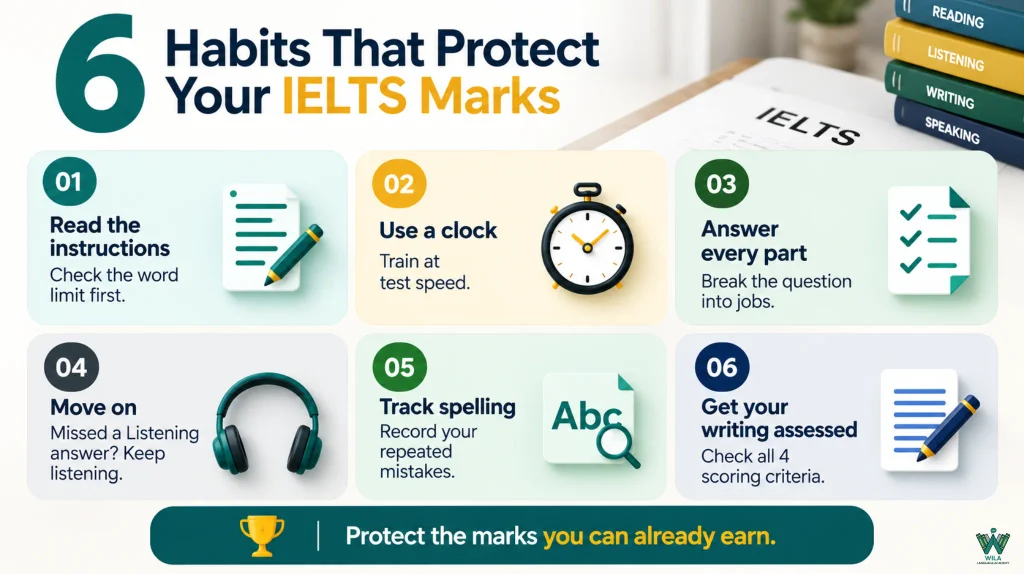
None of these common IELTS mistakes need better English to fix. They need six habits, starting with your next practice test.
- Read the instruction line before every set of questions. Circle the word limit. This single habit protects more marks than any vocabulary list.
- Practise with a clock from day one. 20 minutes for Task 1, 40 for Task 2, under 90 seconds a reading question. Working at speed is a skill of its own.
- Break every essay question into jobs, and write your opinion in one sentence first. At the end, check that each paragraph answers one of those jobs.
- Never go back for a Listening answer you missed. Practice leaving the gap. It feels wrong, and it saves the next answer.
- Keep a list of the words you spell wrong in practice tests. Most people misspell the same twenty words every time.
- Get your writing marked against the four criteria, not just corrected for grammar. Those are Task Response, Coherence and Cohesion, Lexical Resource, and Grammatical Range and Accuracy. A red pen on your grammar will never tell you that you answered half the question.
That last one is hard to do alone, because you cannot see the gap in your own answer. It is what our IELTS Preparation Course is built around: live classes, Academic and General Training tracks, full-length mock tests, and feedback mapped to the criteria you are scored on. If you are still at the starting line, our guide to IELTS preparation for beginners covers what to build first.
WILA Languages is a private language-training provider. We are not an authorized IELTS examination centre, and no course can guarantee a band score, an admission, a visa or a job.
Conclusion
The band you lose is usually not the English you lack. Read the instruction, watch the clock, answer the exact question, and say something of your own in Speaking. Before your next practice test, pick one habit from the list above and work on that alone. Fixing the common IELTS mistakes in this guide protects marks you can already earn, which is faster than raising your level of English.
FAQs
1.Can I retake just one part of the IELTS test?
Sometimes. If your full test was an IELTS on computer test at a centre offering One Skill Retake, you can retake one of the four skills, as long as you book and take it within 60 days of that test. You get one retake per original test, results in three to five days, and you choose which Test Report Form to use (IELTS One Skill Retake).
2.Are common IELTS mistakes the same in Academic and General Training?
The Listening, Speaking and Task 2 mistakes here apply to both. Task 1 differs, since Academic asks you to describe data and General Training asks for a letter, so “answer every part of the question” looks different in each. If you are not sure which test your university or visa route needs, read IELTS Academic vs General Training before you book.
3.Will fixing these mistakes raise my band?
It protects marks you are losing now, which is not the same as raising your English. If your English already sits near the band you need, these common IELTS mistakes are the fastest thing you can fix. If it sits well below, you need study time too, and no technique replaces that.







