

Learning Spanish can mean very different things depending on your goal. You might want to handle basic conversations while travelling, work comfortably with Spanish-speaking clients, study at a Spanish-speaking university, or reach near-native proficiency.
This is where Spanish language levels become useful.
The Common European Framework of Reference for Languages (CEFR) provides a standard way to describe language proficiency from A1 to C2. The framework is used to define learning objectives, develop courses and materials, and assess language ability. (Council of Europe)
But what does each level actually mean, and how long does it take to reach it? Getting familiar with Spanish language levels early makes it much easier to set a realistic study plan instead of guessing at your own progress.
What Are the Spanish Language Levels?
The CEFR divides language proficiency into six levels:
- A1 – Beginner
- A2 – Elementary
- B1 – Intermediate
- B2 – Upper Intermediate
- C1 – Advanced
- C2 – Proficient/Mastery
These levels are grouped into three broad stages: Basic User (A1-A2), Independent User (B1-B2), and Proficient User (C1-C2). This CEFR Spanish scale is the same framework Instituto Cervantes uses to design its own curriculum and DELE exams.
The framework is not simply a list of Spanish grammar topics. It focuses on what learners can actually do with the language. The Council of Europe’s updated CEFR Companion Volume also expands the framework to include areas such as online interaction, mediation and plurilingual competence. (CEFR Companion Volume)
The Instituto Cervantes’ Spanish curriculum follows the same six-level progression, organizing Spanish learning objectives and content from A1 through C2. (Instituto Cervantes)
For a broader look at how these levels compare across languages, see our guide to CEFR language levels.
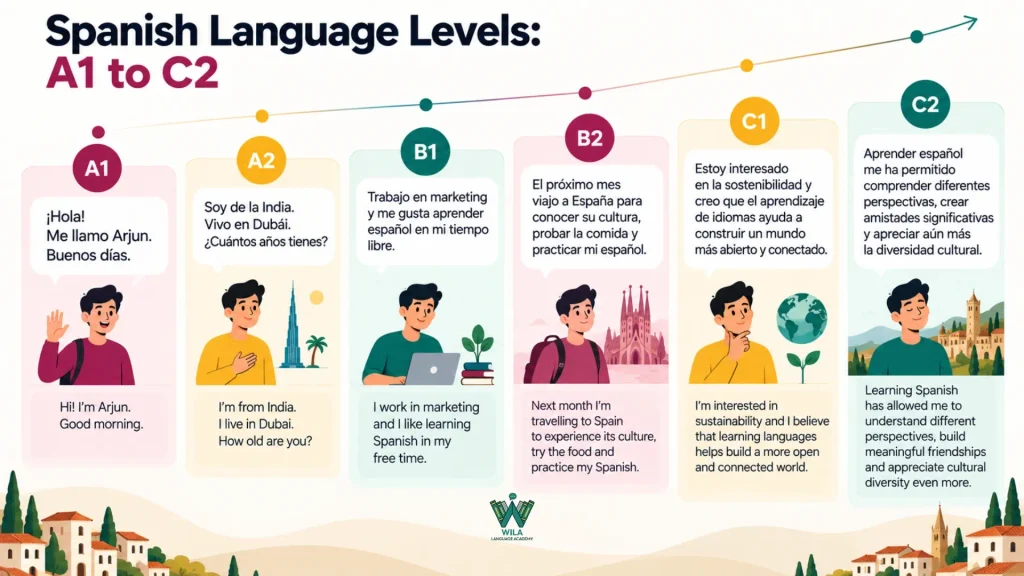
Spanish A1 to C2: What Can You Do at Each Level?
| Level | What You Can Typically Do | Spanish Grammar Focus |
|---|---|---|
| A1 | Introduce yourself, ask simple questions, understand basic expressions and handle simple everyday interactions | Present tense, basic vocabulary, greetings |
| A2 | Handle routine conversations, describe familiar situations and talk about simple past events | Preterite and imperfect, basic connectors |
| B1 | Hold conversations on familiar topics, narrate experiences and express opinions | Subjunctive basics, connectors, present perfect |
| B2 | Communicate with greater fluency, argue viewpoints and understand more complex content | Imperfect subjunctive, conditional structures, passive voice |
| C1 | Express ideas spontaneously, understand implicit meaning and use Spanish effectively in academic or professional settings | Nuanced tenses, register, idiomatic language |
| C2 | Understand virtually everything and communicate precisely across complex contexts | Advanced stylistic and dialectal control |
The progression is therefore about more than learning increasingly difficult Spanish grammar. At A1, the focus is on survival communication; by C1 and C2, learners are expected to handle nuance, abstraction, register and complex ideas. Comparing Spanish language levels side by side like this also makes it easier to spot exactly how far you still have to go from your current level to your target.
How Long Does It Take to Learn Spanish?
There is no fixed number of hours required to reach a particular Spanish level. Your previous language experience, study intensity, exposure outside class and learning environment can all affect progress.
As a general CEFR benchmark, Cambridge English estimates approximately:
| CEFR Level | Approx. Guided Hours From Beginner |
|---|---|
| A1 | 90-100 |
| A2 | 180-200 |
| B1 | 350-400 |
| B2 | 500-600 |
| C1 | 700-800 |
| C2 | 1,000-1,200 |
These figures are general CEFR learning-hour guidelines, not a guarantee for Spanish specifically.
For Spanish, the U.S. Department of State’s Foreign Service Institute classifies it as a Category I language for native English speakers and estimates around 600-750 classroom hours to reach its professional working proficiency target.
So, if you’re planning a Spanish language course, use these figures as planning benchmarks rather than a deadline. Consistent practice, exposure and the quality of instruction can make a substantial difference. These hour ranges only make sense once you can place yourself correctly among the Spanish language levels in the first place.
How Do DELE and SIELE Relate to Spanish Language Levels?
If you want formal proof of your Spanish proficiency, two names you’ll commonly encounter are DELE and SIELE.
DELE: Official Spanish Certification
The DELE (Diplomas de Español como Lengua Extranjera) is an official Spanish certification awarded by Instituto Cervantes on behalf of Spain’s Ministry of Education. The general DELE exams cover A1 through C2 and have indefinite validity. (Instituto Cervantes – DELE)
DELE exams assess language ability through structured examination tasks. Instituto Cervantes provides official preparation guides and sample papers for all six levels, making it possible to understand what each exam expects before registering. (DELE preparation resources)
SIELE: A Flexible Digital Alternative
SIELE is another internationally recognized Spanish proficiency examination and is designed around a digital testing format. It can be useful for learners who want an assessment of their current Spanish proficiency without necessarily pursuing a traditional diploma pathway.
The important distinction is that your CEFR level describes your proficiency, while DELE or SIELE can provide evidence of that proficiency. For a wider comparison of DELE, SIELE and other recognized language exams, see our guide to language certifications.
What Should You Learn at Each Spanish Level?
Knowing your level is useful, but knowing what to study next is even more practical.
A1-A2: Build Your Foundation
At Spanish A1, focus on introductions, everyday vocabulary, numbers, family, routines and simple questions. You should gradually become comfortable with basic present-tense structures and common expressions.
At A2, expand into routine conversations, descriptions and simple past events. Instituto Cervantes’ level-based curriculum places increasing emphasis on practical communication across everyday contexts. (Instituto Cervantes)
B1-B2: Become an Independent Speaker
B1 is where Spanish starts becoming more functional for real-world communication. You should be able to narrate experiences, express opinions and manage common travel or professional situations.
At B2, the focus shifts towards fluency, argumentation and understanding more complex material. This is also where grammar such as the imperfect subjunctive, conditional structures and more advanced connectors becomes increasingly important.
C1-C2: Develop Precision and Nuance
At C1, you should be able to use Spanish flexibly in demanding academic, professional and social situations, including understanding implicit meaning.
C2 represents the highest CEFR level. The goal is not simply knowing more vocabulary or grammar, but being able to understand and express precise shades of meaning across complex contexts.
Not every Spanish language course offers C2, so learners targeting this level may need more specialized study and independent practice.
Which Spanish Language Level Do You Need?
The right target depends on what you want to do with Spanish.
- Independent everyday communication: B1
- Work, study and confident interaction: B2
- Advanced academic or professional use: C1
- Near-complete mastery: C2
Matching your goal to one of these Spanish language levels first prevents you from over-preparing for a certificate you don’t actually need.
If you need a formal qualification, check the specific requirement of your university, employer or immigration authority before choosing an exam.
And remember: Spanish language levels are milestones, not labels of how “good” you are at Spanish. They give you a clearer way to identify your current ability, set a realistic target and choose the right learning path.
If you’re starting from scratch, a structured Wila Language‘s Spanish language course can help you progress systematically rather than trying to study everything at once. For context on why Spanish specifically might be worth that investment, see our piece on why learn Spanish.
Frequently Asked Questions About Spanish Language Levels
1. What are the six Spanish language levels?
The six CEFR Spanish levels are A1, A2, B1, B2, C1 and C2, progressing from beginner to proficient/mastery level.
2. Is Spanish A1 good for beginners?
Yes. Spanish A1 is the beginner level and focuses on basic vocabulary, introductions, simple questions and everyday communication.
3. Is B2 Spanish considered fluent?
B2 represents upper-intermediate proficiency. At this level, learners can generally communicate with considerable fluency and interact with native speakers on a broad range of topics, although C1 and C2 represent more advanced control.
4. How long does it take to reach C1 Spanish?
General CEFR benchmarks put C1 at around 700-800 guided learning hours from beginner level, although the actual time varies considerably. The FSI estimates 600-750 classroom hours for its Spanish professional-working-proficiency target, which is not directly equivalent to every CEFR level.
5. Are DELE and SIELE the same?
No. Both assess Spanish proficiency, but they are different certification systems. DELE is an official diploma covering A1-C2, while SIELE provides a digital proficiency assessment.
6. Which Spanish level should I aim for?
For basic communication, A1-A2 may be enough. B1-B2 is a more practical target for independent communication, while C1-C2 is appropriate for advanced academic, professional or mastery-level goals. Whichever target you pick, understanding the full run of Spanish language levels first will help that decision make sense.







