

Learning a new language can support different goals, from studying or working abroad to meeting immigration requirements, relocating, or communicating more confidently in everyday life. Once you know what you want to achieve, the next question is how you should learn.
Should you choose an online language course or attend classes in person?
The answer is not as simple as saying one format is better than the other. A scoping review in Frontiers in Education found that research comparing online and face-to-face education is highly varied, partly because “online learning” can include synchronous classes, asynchronous courses, mobile learning and blended models. What matters is how the course is designed, how much speaking practice you get, how consistently you attend, and how well the format fits your circumstances.
Online vs Classroom Language Courses: Key Differences
| Factor | Online Language Courses | Classroom Language Courses | Better choice if… |
|---|---|---|---|
| Flexibility | Learn from anywhere and choose suitable timings | Usually follows fixed schedules | You have changing work, college, or family commitments → Online |
| Face-to-face interaction | Interaction happens through live video classes | Direct interaction happens naturally in class | You learn best through in-person communication → Classroom |
| Speaking practice | Strong when classes are live and interactive | Naturally integrated into classroom activities | You need frequent conversation practice → Either, depending on course design |
| Accountability | Depends on live schedules and your self-discipline | Fixed schedules provide external structure | You need a strong routine → Classroom |
| Lesson revision | Recordings and digital resources can support revision | Usually depends on notes and available materials | You like revisiting difficult topics → Online |
| Location | Access courses regardless of where you live | Limited to institutes and batches nearby | Your preferred language or level is unavailable locally → Online |
| Learning environment | Convenient but may involve home distractions | Dedicated learning environment | You struggle to focus at home → Classroom |
| Digital resources | Easy access to recordings, exercises, quizzes and other tools | Depends on the course | You prefer technology-supported learning → Online |
| Travel | No regular commute to the institute | Requires travel to and from class | Travel is difficult or time-consuming → Online |
| Blended potential | Can combine live teaching with independent practice | Can also incorporate digital resources | You want structure plus flexibility → Blended |
The table gives you the basic distinction, but the more important question is what research says about effectiveness, speaking practice, consistency and blended learning.
Is Online Language Learning as Effective as Classroom Learning?
There is no universal winner.
The Frontiers in Education scoping review, which mapped 20 systematic reviews, found that evidence comparing online and traditional education is methodologically fragmented. It also noted that “online education” covers very different formats, making a simple comparison difficult.
Language-specific research points in different directions.
Research involving 3,651 students in an Arabic language course found that face-to-face instruction produced better results than online learning, with a moderate effect size. (MDPI)
The picture changes in other language-learning contexts. A comparison of online and conventional English teaching found stronger online gains in pronunciation and vocabulary, while classroom instruction performed better for spontaneous responses and face-to-face communication.
So the better question is not:
“Is online better than classroom learning?”
It is:
“Which format gives me the type of learning experience I need?”
For language learning, that usually means looking at five things: speaking practice, feedback, consistency, flexibility and opportunities for independent practice.
WILA Languages offers live, instructor-led online language courses designed to combine structured learning, speaking practice, feedback, and flexible learning—helping you build communication skills for career growth, study abroad, travel, and global opportunities.
What Matters More Than the Format?
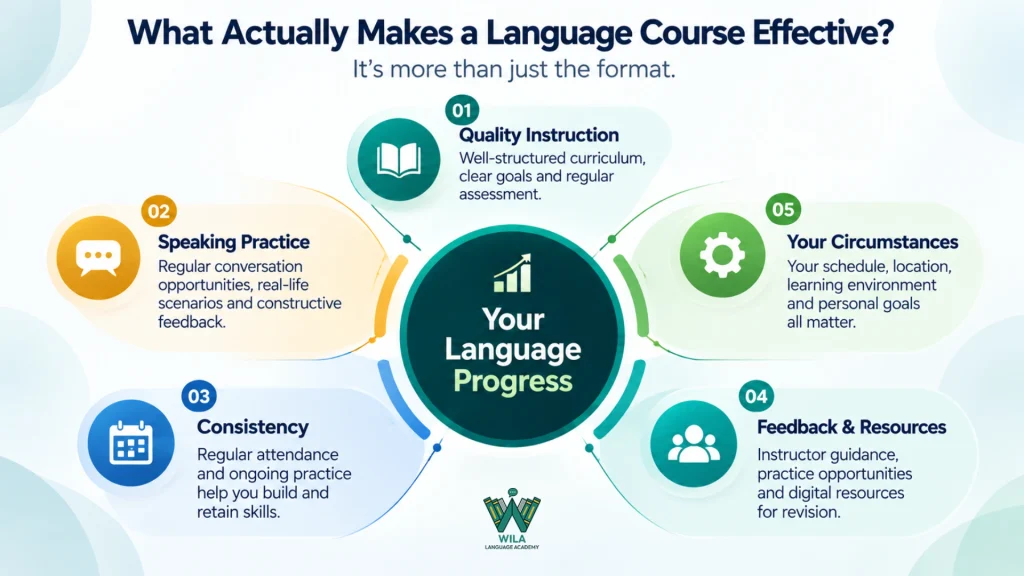
The format matters, but it is only one part of the equation.
1. Quality of instruction
A well-designed online course with a qualified instructor can be more useful than a poorly structured classroom course. The same applies in reverse.
Look for a course with a clear curriculum, appropriate level progression, regular assessment and meaningful instructor feedback.
2. Speaking practice
Knowing vocabulary and grammar does not automatically make you comfortable speaking.
The online-versus-conventional English comparison found that classroom instruction had advantages in spontaneous responses and face-to-face communication, while online instruction performed better in some technical language areas.
That means the important question is not simply whether a course is online or offline. Ask:
- How often will I speak?
- Will I interact with other learners?
- Will the instructor correct my mistakes?
- Will I have opportunities to use the language spontaneously?
3. Consistency
Language learning requires regular exposure and practice.
Research on synchronous online and on-campus language training found a strong relationship between attendance and exam performance. Students also reported that on-campus classes felt more motivating and interactive, while online learning provided greater flexibility and higher homework completion.
The lesson is simple: the best course is one you can attend consistently.
4. Feedback and practice outside class
Class time alone is rarely enough.
A systematic review of more than 70 studies on computer-assisted language learning found benefits across multiple language skills, particularly when technology was integrated into structured learning with feedback.
5. Your circumstances
A classroom course may be excellent, but it is not useful if the timing, location or available level does not work for you.
Likewise, an online course may be convenient, but if you consistently struggle to focus or attend virtual sessions, the flexibility may not translate into progress.
Which Learners Benefit Most From Online or Classroom Learning?
Instead of treating online and classroom learning as completely separate categories, consider which environment better matches your needs.
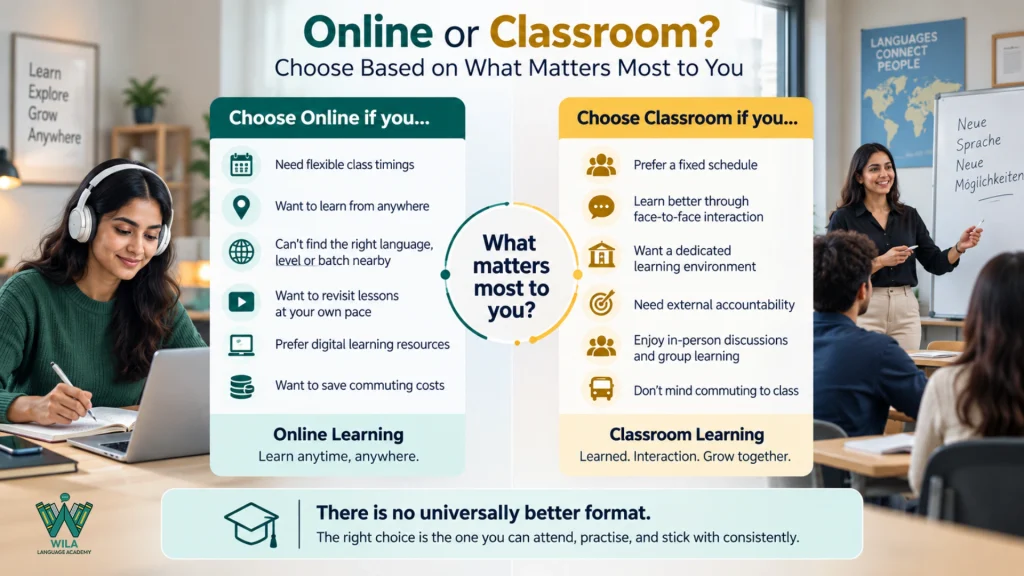
Online language courses may suit you if:
- You need flexibility: If you work full-time, attend college or manage family responsibilities, online classes can remove the need for regular commuting and make it easier to fit learning around your schedule.
- Your preferred course is not available nearby: Classroom choices depend on local institutes, batches and timings. Online learning can give you access to courses beyond your immediate location.
- You benefit from revision: Recorded lessons and digital resources can make it easier to revisit difficult concepts. Research on asynchronous digital language instruction has reported improvements in listening and speaking, although it also identified challenges around motivation and reduced real-time interaction.
- You are comfortable with some independent learning: Online learning gives you greater control over when and where you study, but you still need to manage your time and attend sessions consistently.
- You want technology-supported practice: Online courses can combine live instruction with digital exercises, multimedia resources, revision materials and additional practice.
Importantly, a live online language course is not the same as learning entirely through an app or recorded videos. Instructor interaction, feedback and structured speaking practice still matter.
Classroom language courses may suit you if:
- You need a fixed routine: A scheduled class creates an external commitment and can make learning easier to maintain if you tend to postpone self-directed study.
- You learn through face-to-face interaction: Direct interaction can make spontaneous conversation, immediate responses and group activities easier. Research has found advantages for classroom learning in spontaneous response generation and face-to-face communication.
- You benefit from external accountability: Having an instructor and classmates physically present can create stronger pressure to attend and participate.
- You focus better away from home: If online classes expose you to constant phone, work or household distractions, a dedicated classroom environment may make it easier to concentrate.
Ultimately, neither format is automatically better. The stronger choice is the one that makes it easier for you to attend consistently, practice speaking, receive feedback and keep learning over time.
What About Blended Language Learning?
Blended learning combines instructor-led teaching with online or digital learning activities, such as live classes, recorded lessons, digital exercises and self-paced revision.
Research is particularly encouraging. A meta-analysis of 28 studies and 33 effect sizes found a strong positive effect of blended learning on English proficiency, particularly listening and speaking.
For language learners, blended learning can combine:
- Structure + flexibility
- Live interaction + independent practice
- Instructor feedback + digital revision
- Accountability + self-paced learning
If you want the benefits of both online and classroom approaches, blended learning may be worth considering.
What Role Does AI Play in Language Learning?
AI can strengthen language learning, but it should supplement rather than replace instructors.
A systematic review of 22 studies on AI-assisted language learning found improvements most frequently in pronunciation, followed by fluency, vocabulary and grammar.
A separate meta-analysis of AI-supported English instruction found a substantial overall effect, including particularly strong results for speaking.
However, AI cannot replace human guidance, structured practice and meaningful interaction. A review of 14 systematic reviews and meta-syntheses supports a pedagogy-first approach, where AI works alongside instruction.
For language learners, the stronger model is therefore:
Teacher + digital resources + AI-supported practice.
Which Format Is Right for You?
Choose an online language course if you need flexibility, want to avoid commuting, prefer recorded resources, or cannot find your desired language or level nearby.
Choose classroom learning if you learn better through face-to-face interaction, need a fixed routine, or benefit from stronger accountability and a dedicated learning environment.
If you want to combine structured instruction with flexibility and independent digital practice, blended learning may be the better fit. Ultimately, choose the format that makes it easiest for you to learn consistently, practice speaking, receive feedback and stay engaged.
Online Language Courses at WILA Languages
If you’ve decided that online language courses fit your schedule and learning style, the next question is which provider actually delivers on that promise.
WILA Languages offers online German, French and Spanish language courses, with programmes aligned with the CEFR framework. Its current language programmes cover A1 to C2, depending on the language and programme.
The CEFR framework provides six common reference levels — A1, A2, B1, B2, C1 and C2 — that describe language proficiency and provide a common basis for learning objectives, curricula, courses and examinations. For a full breakdown of what each level means, see our guide to CEFR language levels.
WILA Language’s online language classes are live and instructor-led, rather than purely self-paced. Live classes, not recordings, are the backbone of the WILA Language model. Its German, French and Spanish course pages describe live instruction, CEFR-aligned curricula and speaking-focused learning.
The learning experience can therefore combine:
- Live instructor-led classes
- Speaking and conversation practice
- Digital learning resources
- Vocabulary and grammar practice
- Assignments and assessments
- Instructor feedback
- AI-supported practice tools
Whether you are learning for work, study abroad, relocation, certification or personal development, WILA Language’s online language courses are designed to provide structured instruction and regular opportunities to practice. If you’re weighing which language actually fits your goals before you commit to a course, our guide to choosing a language and our overview of recognized language certifications cover that groundwork.
Frequently Asked Questions
1. Is online language learning as effective as classroom learning?
It can be, but there is no universal answer. Research shows mixed results because online learning includes very different formats, from live virtual classes to self-paced digital learning. The quality of instruction, amount of interaction, feedback and learner consistency all matter.
2. Is online learning good for speaking practice?
Yes, especially when the course includes live instructor-led sessions, conversation activities and regular feedback. However, research suggests that face-to-face classes may offer advantages for spontaneous interaction and direct communication.
3. Can I learn a language online while working full-time?
Yes. Online language courses can make it easier to fit live lessons around working hours and reduce commuting time. Recorded sessions and digital resources can also support revision when your schedule becomes busy.
4. Is blended learning better than choosing only online or classroom learning?
Blended learning can be highly effective because it combines live instruction with independent digital practice. A meta-analysis of blended language learning found a strong positive effect on English proficiency, particularly for listening and speaking.
5. Are WILA Language’s online language classes live or recorded?
WILA Language’s online language classes are live and instructor-led. Its course pages also describe digital learning resources and structured course materials that support learning beyond the live sessions.
6. Can beginners take WILA Language’s online language courses?
Yes. WILA Language’s German, French and Spanish programmes include beginner-level A1 courses, and its Spanish course and French course pages state that beginners can start without prior experience.
7. What language levels are available at WILA Languages?
WILA Language’s German, French and Spanish programmes follow the CEFR framework, with programmes extending from A1 to C2.
8. Does WILA Language provide speaking practice?
Yes. WILA Language’s course pages describe practical speaking-focused learning through live, instructor-led classes and communication activities.







