


Most people who set out to learn German begin the same way. They download an app, learn to say Guten Morgen and how to order a coffee, and feel like they have started. A few weeks later they have a handful of travel phrases, the lessons get skipped, and it quietly ends.
Here is what nobody tells them. Almost none of the real benefits of German, the job offer, the tuition-free university seat, the higher salary, sit at that beginner level. They sit at B1 and above. So the useful question is not whether to learn German. It is how far you actually need to take it for the thing you want.
Should you learn German?
If you plan to study, work or build a career in Germany, Austria or Switzerland, yes. But the payoff depends on your level. Basic German (A1 to A2) helps you settle in. The real career, university and salary benefits begin at B1 to B2, and regulated fields like medicine need C1.
Is learning German worth it?
German is not a niche language. Around 100 million people speak it as their mother tongue, the most widely spoken native language in the European Union, according to Germany’s Federal Foreign Office. It is also the language of Europe’s largest economy, and official in Austria and Switzerland too.
That economy has a problem that works in your favour. The German Economic Institute projects Germany will be short about 723,000 skilled workers by 2029, nearly double the 2025 gap. But scale alone is not a personal benefit. Knowing 100 million people speak German does nothing for your career if your own German stops at Danke. Among the reasons to learn German, that is the one that matters: the payoff is real, but it is earned at a level, not at hello.
What level of German do you need?
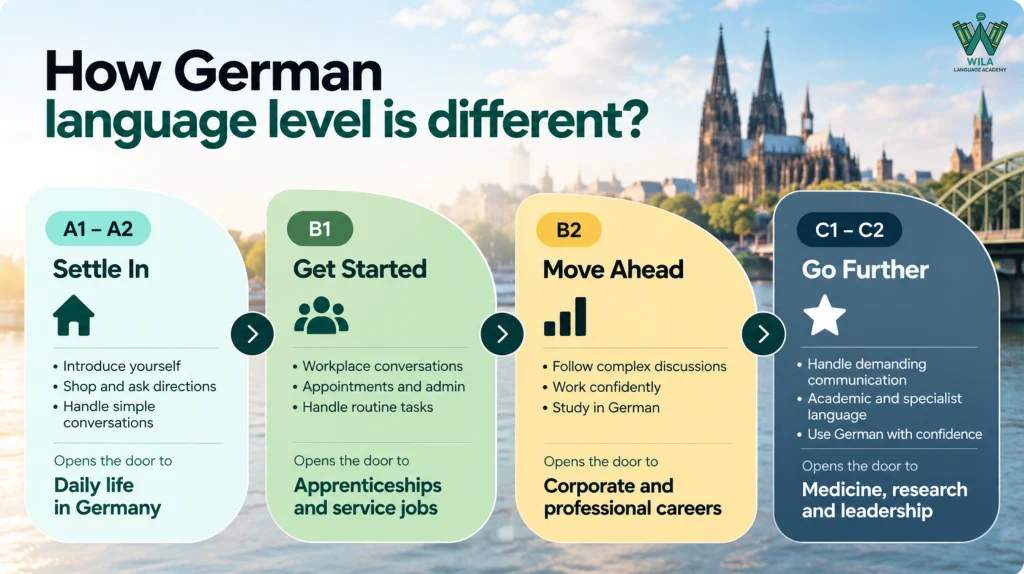
The German language benefits people care about do not arrive evenly as you study. They cluster at specific levels, which is the key thing to grasp before you learn German any further. The Common European Framework (CEFR) sorts proficiency into six levels: A1 and A2 (basic user), B1 and B2 (independent user), C1 and C2 (proficient user). Here is what each range actually unlocks.
| CEFR level | What you can realistically do | What it unlocks |
|---|---|---|
| A1 to A2 | Greetings, shopping, directions and simple daily exchanges | Settling in and everyday life. Not a job qualification on its own. |
| B1 | Every day and routine workplace conversation, appointments and admin | Apprenticeships (Ausbildung), many service and hospitality jobs |
| B2 | Work and study in German with confidence, follow complex discussion | Most corporate and professional roles, entry to German-taught degrees |
| C1 to C2 | Near-native command in demanding academic and professional settings | Medicine and regulated professions, research and leadership roles |
Take two people who both say they know German. One stopped at A1 with travel phrases. The other pushed to B2. Only the second can apply for the roles that pay the salaries below. Same language on a CV, completely different doors. That is why it pays to learn German to a target level, not just to dabble.
What German jobs can you get?
Most professional German Jobs that expect the language want B2. That covers most corporate, engineering, IT and business roles at firms like Siemens, Bosch, SAP and BMW. At B1 you reach apprenticeships and customer-facing work. Regulated fields sit higher: to practise medicine, most German state medical boards require around C1 with a specialist language exam.
The pattern across Germany careers is simple, the better the role, the more German it expects. You do not have to move abroad either: more than 2,000 German companies operate in India, from Bosch to Mercedes-Benz, many of them rewarding people who can work directly with German teams.
German salary: how much can you earn?
Germany pays well. Full-time employees earned €4,784 in average gross monthly pay in April 2025, according to the Federal Statistical Office, and the StepStone Salary Report 2025 put median full-time pay near €45,800 a year. Software roles commonly sit around €60,000 and climb past €90,000 for AI specialists, with experienced engineers and doctors earning more still. Figures vary, so verify current bands.
The language does not add a salary line by itself. It opens the door to the roles that pay these figures, almost all of them conducted in German. That is why the German Salary benefit is really a B2-and-above benefit.
Study in Germany: what it costs
Germany is one of the few places a strong degree can cost almost nothing. Most public universities charge no tuition, with a few exceptions such as Baden-Württemberg (about €1,500 per semester for non-EU students). Otherwise you pay only a semester contribution of roughly €100 to €350. The catch is language: German-taught degrees generally require B2 to C1, proven with TestDaF or the DSH exam.
English-taught programmes exist but are a minority, and admission to one is not the same as being able to live and work in the country. Students can now work 140 full days or 280 half days a year, raised by the 2024 Skilled Immigration Act, and with German those days can be a paid working-student role rather than English-only gig work. For the visa, non-EU students usually show funds through a blocked account, set at €11,904 in 2025. Confirm the current figure before you apply, since it changes.
How long does it take to learn German?
Honest answer: nobody can promise you a timeline, and anyone who gives you a fixed one is selling something. The Goethe-Institut, the official body for German as a foreign language, publishes guided-hour ranges as a benchmark, not a guarantee: roughly 50 to 75 hours to reach A1, another 100 to 150 each for A2 and B1, and around 150 to 225 for B2.
It says plainly that “individual aspects such as language learning experience and native language also play an important role.” How long it takes to learn German depends on your starting point, the languages you already know, and how much you use it outside class. Treat the hours as a map of the distance, not a deadline.
“If you talk to a man in a language he understands, that goes to his head. If you talk to him in his language, that goes to his heart.” Nelson Mandela’s line is the part that keeps people going: in a German-speaking country, the language is the difference between visiting and belonging.
How WILA Languages helps you learn German
If the level you need is B1 or B2, how you get there matters. Apps are fine for a first hundred words. They rarely carry people to a working level: they cannot correct your speaking, keep you to a schedule, or push you past the intermediate wall where most learners quit. That is the gap live teaching fills.
WILA Languages runs structured, CEFR-aligned German courses from A1 to C2, taught live by instructors and available in several Indian languages, so you can learn German the way it eventually has to be used, in real conversation. You start at the level that matches your goal and build from there.
FAQs about learning German
1.What level of German do I need to work in Germany?
Most professional roles expect B2. Apprenticeships and many service jobs accept B1, while regulated fields such as medicine usually require C1 with a specialist language exam. English-only roles exist but are a shrinking minority.
2. Can I study in Germany in English?
Yes, some degree programmes are taught in English and need no German. But they are a minority, and you will still need German to work part-time, handle daily life and stay on to work after you graduate.
3. Is €70,000 a good salary in Germany?
Yes. It sits well above the roughly €45,800 median full-time pay reported by StepStone for 2025, though your take-home depends on your tax class and city.
4. Can I get permanent residency after studying in Germany?
Often, yes. Graduates who find qualified work and meet the residence conditions can apply, and stronger German helps both the job search and the settlement process. Check current rules with the Federal Office for Migration and Refugees.







