


Getting admission to a university in France is not only about meeting the academic requirements. You also need to know which language your programme is taught in, what level of proficiency is expected, and which test or certificate the university will accept as proof.
The French language requirement can vary significantly between programmes. For a French-taught course, you will generally need evidence of French proficiency. For an English-taught programme, French may not be required for admission, but you may need to prove your English proficiency instead.
The important point is that there is no single French language requirement that applies to every international student. Your study level, programme, institution, and application route can all affect what you need.
This guide explains the French language requirement for French-taught and English-taught programmes, the main French tests and diplomas you may encounter, possible exemptions, and how language requirements differ from the France Student Visa process.
French language requirement for French-taught programmes
If your programme is taught in French, you need enough proficiency to follow lectures, participate in discussions, complete written work and take examinations.
French universities and higher education institutions commonly use the CEFR (Common European Framework of Reference for Languages) to describe language proficiency. It ranges from A1 to C2.
| CEFR level | What it generally means |
|---|---|
| A1 | Can understand and use very basic French |
| A2 | Can handle simple, routine communication |
| B1 | Can communicate independently in familiar situations |
| B2 | Can manage more complex academic and professional communication |
| C1 | Can understand and express complex ideas effectively |
| C2 | Can communicate with a very high level of precision and nuance |
There is no universal CEFR level for every French-taught programme.
Campus France states that B1 or B2 is recommended for undergraduate and Master’s study, while B2 is required for first-year admission through the DAP route. Some institutions and programmes may require C1 or C2. (Source: Campus France)
So, B2 is an important benchmark, but it should not be treated as the French language requirement for every university or course.
The exact requirement belongs to the programme you are applying for.
Which French tests are accepted by universities?
Once you know the required CEFR level, the next question is which qualification or test you can use as proof.
The main options you may encounter are:
| Test or diploma | Levels / purpose |
|---|---|
| DELF | A1 to B2 |
| DALF | C1 and C2 |
| TCF | French proficiency test covering A1 to C2 |
| TEF | French proficiency test used for academic and administrative purposes |
DELF and DALF are diplomas awarded at specific CEFR levels, while TCF and TEF are proficiency tests that assess your current level. France Éducation international confirms that DELF covers A1 to B2 and DALF covers C1 to C2.
Campus France also lists DELF, DALF, TCF and TEF among the recognized ways of demonstrating French proficiency for higher education (Source: Campus France India)
However, a recognized test is not automatically the right test for every application.
For example, DELF B2 may meet the requirement for one programme, while another may specifically require C1. Some admission routes can also have their own rules about which tests are accepted.
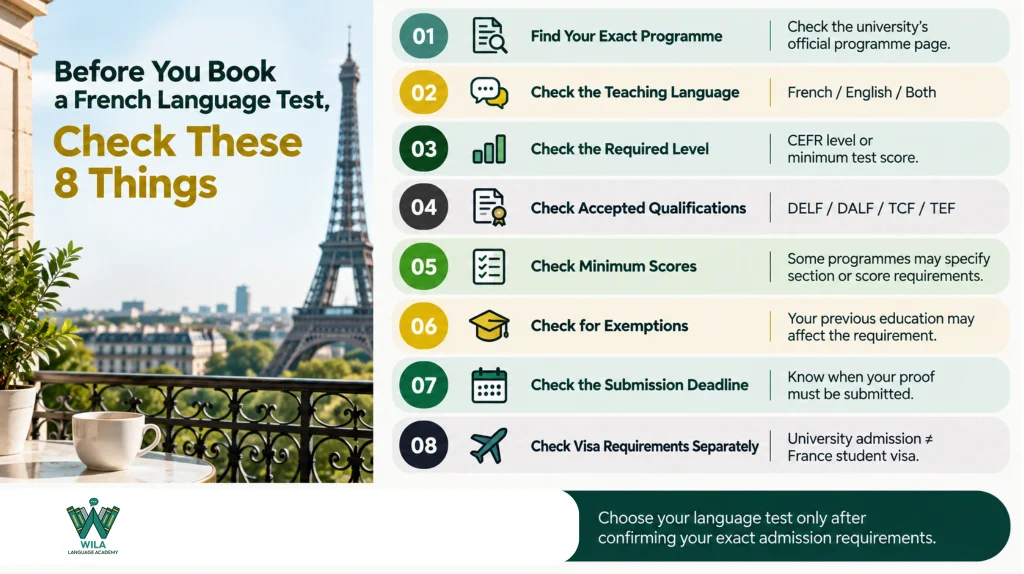
Before registering for an exam, check your programme’s admission page for:
- the required CEFR level;
- accepted tests or diplomas;
- minimum scores, where applicable;
- the deadline for submitting proof;
- any programme-specific conditions.
For a closer comparison, see our guide to DELF vs DALF.
Do you need French for an English-taught programme?
Not necessarily. If your programme is taught in English, French is generally not required simply because you are studying in France. Campus France states that students enrolled in English-taught programmes may instead need to demonstrate their English proficiency. (Source: Campus France)
The distinction is simple:
- French-taught programme: French proficiency may be required.
- English-taught programme: English proficiency may be required instead.
The exact English language requirement depends on the university and programme. Accepted proof can include IELTS Academic, TOEFL iBT, Cambridge English qualifications or another test specified by the institution.
The required score can also vary. One programme may specify a particular IELTS score, while another may accept a different test or provide an exemption based on your previous education.
So, do not assume that IELTS is mandatory for every English-taught programme. Check the exact admission requirements before booking a test.
If you are unsure which IELTS format applies to your plans, see our guide to IELTS Academic vs General.
Can you get a language-test exemption?
Possibly, but there is no single exemption rule that applies to every international student.
For French-taught programmes, exemptions can depend on your nationality, previous education, qualifications and the specific admission route. Campus France identifies certain situations in which applicants may be exempt from providing standard French-language proof, including specific French educational backgrounds. (Source: Campus France)
English-taught programmes can also have their own exemption rules. Some universities may accept previous education conducted in English or another specified qualification instead of a standard English test.
The key point is that an exemption must be confirmed by the institution or application procedure.
Do not assume that you need a test when you may already qualify for an exemption. At the same time, do not skip a required test because a general exemption rule appears to apply to you.
Check the admission requirements for your exact programme and educational background.
French language requirement and the France Student Visa
Your university admission requirement and your France Student Visa requirement are separate parts of the process.
The university decides whether you meet its academic and language requirements. The visa process determines whether you meet the conditions for entering France for your studies.
France-Visas states that students must have been accepted by a higher education institution and provide the supporting documents applicable to their situation. The exact requirements depend on factors such as nationality and individual circumstances. (Source: France-Visas)
Depending on your nationality and application route, you may also need to complete the relevant Campus France procedure before submitting your visa application.
This is why you should not treat university admission and the France Student Visa as one checklist. First identify what your university requires for admission, then verify the current visa procedure that applies to you.
Do you need French even if your course is in English?
For admission, not necessarily.
For everyday life in France, however, French can still be useful.
Even if your classes are entirely in English, knowing some French can help you:
- communicate in shops, restaurants and public transport;
- handle accommodation and everyday appointments;
- interact with people outside your university;
- build relationships with local communities;
- explore internships or part-time opportunities where French is useful.
Campus France also highlights opportunities for international students to learn French while studying in France. (Source: Campus France)
So, an English-taught programme can reduce the French language requirement for admission without making French irrelevant to your experience in France.
For more on the academic, career and everyday benefits of learning French, read our guide to Why Learn French? Career and Study Abroad Benefits.
How to check the exact language requirement
Do not start by choosing a French exam.
Start with the programme.
Use this process:
1. Find your exact programme on the university’s official website.
2. Confirm whether it is taught in French, English or both.
3. Check the required CEFR level or minimum test score.
4. Check which French or English qualifications are accepted.
5. Check whether your previous education qualifies you for an exemption.
6. Confirm when you need to submit your language proof.
7. Check whether any additional admission procedure applies to your nationality or programme.
8. Verify the current France Student Visa requirements separately.
This approach helps you avoid preparing for the wrong test or discovering a language requirement after you have already started your application.
Common French language requirement mistakes to avoid
Assuming B2 is required everywhere
B2 is an important level for many French-taught programmes, but it is not universal. Some programmes require C1 or another specified level.
Assuming French is required for every programme
France has many programmes taught in English. Always check the actual teaching language of your chosen course.
Choosing an exam before checking the university
DELF, DALF, TCF and TEF are recognized options, but the important question is whether your specific programme accepts the test or diploma and level you plan to submit.
Treating admission and visa requirements as the same thing
They are separate processes. Your university determines its admission requirements, while France-Visas determines the visa requirements applicable to your situation.
Assuming you qualify for an exemption
Your previous education or qualifications may affect whether you need a language test, but exemption rules depend on the institution and application route.
Build your French skills before studying in France
If your target programme requires French, passing a test is only one part of the process. You also need enough proficiency to understand academic content and communicate effectively.
WILA Languages offers structured French language courses aligned with CEFR progression, with instructor-led learning and preparation for recognized French certifications such as DELF and DALF.
Conclusion
There is no single French language requirement for everyone planning to study in France.
What you need depends on your programme, teaching language, study level, institution and accepted forms of language proof. French-taught programmes generally require evidence of French proficiency, while English-taught programmes may require English proficiency instead.
The safest approach is simple: find your exact programme first, identify its required level and accepted proof, and only then choose the appropriate test or qualification.
If you are preparing to study in France, understanding this requirement early can help you avoid choosing the wrong test, missing a deadline or confusing admission requirements with visa requirements.
Frequently Asked Questions
1.What is the French language requirement for studying in France?
There is no universal requirement. French-taught programmes may require B1, B2 or a higher level depending on the programme, while English-taught programmes may not require French for admission.
2. Can I study in France without knowing French?
Yes. If you are accepted into an English-taught programme and the institution does not require French, you can study without demonstrating French proficiency. French can still be useful for everyday life.
3. Is IELTS required to study in France?
Not necessarily. English-taught programmes may require IELTS, TOEFL, Cambridge English or another form of English-language proof. Requirements and exemptions vary by institution.
4. Is B2 French enough to study in France?
B2 may meet the requirement for many French-taught programmes, but it is not sufficient for every course. Some programmes require C1 or another specified level.
5. Are DELF and DALF accepted by French universities?
They can be used to demonstrate French proficiency. DELF covers A1 to B2, while DALF covers C1 and C2. You should still confirm the qualification and level accepted by your chosen programme.
6. Is French required for a France Student Visa?
French is not automatically required for every student visa applicant. The language requirement generally comes from the study programme, while visa applicants must meet the France-Visas requirements applicable to their situation.
7. How do I know which French test I need?
Start with your university programme. Check the required CEFR level and accepted tests or diplomas. Then choose the qualification that matches both the programme’s requirements and your current proficiency.







