

You followed the whole client call. You knew the answer to the question your manager was asked. You had it ready, in order, in your head. Then the moment arrived, someone else spoke first, and you let it go. Two hours later you wrote the same point in an email, in better English than anyone used on that call.
If that is familiar, your English Communication Skills may need a different kind of practice. The usual advice will not help. Read more books, watch English films, learn ten new words a day. None of it is aimed at what actually happened in that meeting.
your English communication skills at work are limited less by what you know and more by what you can produce under time pressure, in front of people. Reading and listening build knowledge. Only speaking builds speaking. The six tips below come from research on how spoken output actually improves.
e clearest evidence comes from two multinational companies that had made English their official working language. Researchers interviewed 22 employees there, from senior managers to junior staff, none of them native English speakers. What they found was not a shortage of vocabulary. It was anxiety producing three specific behaviours: avoiding the conversation, withdrawing from it, and switching into a shared local language whenever that was possible. These showed up in employees whose English was strong (Aichhorn and Puck, International Business Review, 2017).
That is worth sitting with. The people in that study could do their jobs in English and still went quiet. So a plan for better English communication skills built only on more reading and more vocabulary may be solving a problem you do not have.
What actually improves your English communication skills at work?
Six things, and every one of them builds your English communication skills by making you produce language instead of absorbing it. These are the tips with research behind them, not just repetition across advice sites.
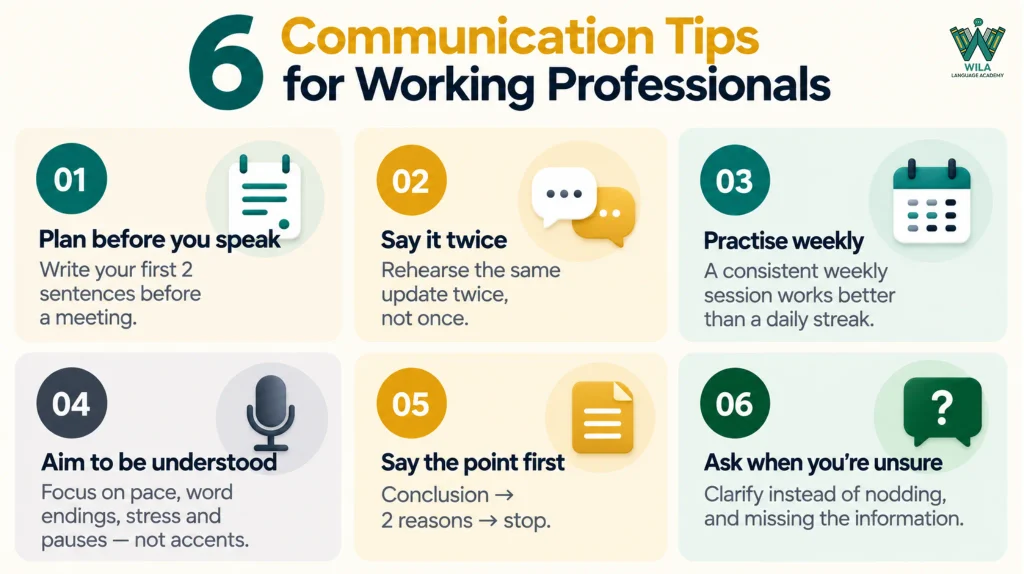
1. Decide your first two sentences before you speak
Planning before you open your mouth has a clean experimental result behind it. When learners were given time to plan before speaking, their speech came out more fluent, more varied in vocabulary and more grammatically complex. When they were instead given room to think while speaking, their accuracy improved (Yuan and Ellis, Applied Linguistics, 2003).
Both help, at different moments. Before a meeting, plan, and write your first two sentences on paper. During the meeting, slow down instead of speeding up, because that extra half second is where your grammar gets fixed.
2. Say the same thing twice
Repeating a task is one of the most reliable ways to improve spoken performance. A 2025 meta-analysis found a medium effect on sentence complexity and a clear gain in accuracy on the second attempt, with smaller gains in fluency and vocabulary. Repeating the same task, rather than a similar one, worked best for sentence structure (Abdi Tabari, Zhuang and Farahanynia, System, 2025).
So say your weekly update out loud twice before you say it in the room. The second run is measurably better than the first. Most people give the meeting their first attempt.
3. Practice weekly, and stop chasing a daily streak
You may not need to practice every day for it to stick. Researchers trained 116 learners on speaking tasks, one group with sessions a day apart and one with sessions a week apart. On tests taken 7 and 28 days later, both groups had improved by a similar amount (Kakitani and Kormos, Studies in Second Language Acquisition, 2024).
That is one study with one group of learners, so treat it as a direction rather than a rule. A weekly slot you keep beats a daily plan you drop in week three.
4. Work on being understood, not on losing your accent
These are two different goals and only one of them changes how your English communication skills land at work. Pronunciation research has treated accent and intelligibility as separate concepts for decades, because a speaker can carry a heavy accent and still be understood perfectly (Munro and Derwing, Language Teaching, 2011).
So stop auditioning for a voice that is not yours. Spend the effort on what genuinely makes listeners lose you: speaking too fast, dropping the ends of words, stressing the wrong syllable, and running three ideas into one sentence with no pause.
5. Say the point first, then the detail
Look at what separates a B2 speaker from a C1 speaker in the official European framework. It is not vocabulary size. At C1 the description is about using language flexibly for professional purposes and producing clear, well-structured points with proper connectors (Council of Europe, CEFR global scale).
That is structure, and structure is learnable this week. Lead with your conclusion, give two reasons, then stop. “We should push the launch by a week. Testing is not finished and the client has not signed off.” Two sentences, no hedging, no run-up. This single habit will do more for your professional English than a month of vocabulary lists.
6. Ask the clarifying question instead of nodding
Nodding when you have not understood is the withdrawal behaviour from that multinational study, and it costs you twice. You lose the information, and you lose the chance to be seen taking part.
Keep three lines ready so you never have to invent them under pressure:
- “Can you say that again, I want to make sure I have it right.”
- “When you say [word], do you mean [your understanding]?”
- “Let me repeat that back to you.”
None of these mark you as weak in English. Native speakers use all three. In most meetings, the person asking the clarifying question is read as the one paying attention.
Which English communication skills does your job actually need?
Not all of them equally, and knowing which one your role leans on tells you where to put your practice time.
The pressure is also rising. In a 2026 survey of HR decision-makers, 81 percent said AI tools were increasing the need for English at work, 92 percent said English mattered more than it did five years ago, and 90 percent called it critical to how their organization performs (ETS, TOEIC Global English Skills Report, 2026).
| Your role mostly involves | Practice this first |
|---|---|
| Client calls, sales, support, delivery | Speaking under time pressure, clarifying questions |
| Internal reporting, documentation, analysis | Structuring a written point, then reading it aloud |
| Managing people or projects | Leading with the conclusion, handling interruptions |
| Working with AI tools daily | Writing precise instructions, checking the output |
Do you need an IELTS or PTE score to prove your English?
Only if an institution or a government is asking for proof. Skill and certificate are two different things, and professionals confuse them constantly.
Nobody in your office will ask for your IELTS band. Your manager judges you on the call you just handled. A university admissions office or a visa authority cannot sit in on your calls, so they ask for a score instead.
| What you want | What you need |
|---|---|
| To speak up in meetings and lead calls | Practice, not a certificate |
| To study abroad | A score the institution accepts, on its terms |
| A work visa or residence route | A score the immigration authority accepts |
| A promotion into a client-facing role | Demonstrated workplace English, sometimes a company test |
Accepted tests and minimum scores change, and they differ by country and by institution. Check the official page for your university, employer or immigration route before you book anything.
How WILA Languages can help
Here is the honest position. WILA Languages teaches German, Spanish and French from A1 to C2 and prepares people for IELTS, PTE and TOEFL. We do not run a business English or spoken English course, so if your only goal is better English communication skills in Monday’s meeting, most of what you need is in the six tips above, plus a colleague willing to let you rehearse.
Where we are useful is the second problem on this page. If your English has to be proved to a university, an employer or an immigration authority, that is its own skill, and the speaking sections are exactly the pressure practice people skip. Our classes are live, with an instructor who hears you speak and corrects you, which is a different thing from a recorded course.
WILA Languages is a private language-training provider. We are not an authorized examination Centre for IELTS, PTE or TOEFL, and no course can guarantee a band score, an admission, a visa or a job.
Conclusion
The silence in that meeting was never a vocabulary problem, so more input will not end it. English communication skills at work improve when you produce the language on purpose before you need it: two sentences planned, one rehearsal done, a clarifying question ready, the conclusion spoken first. Pick one and use it in your next meeting. A test score is a separate job with its own preparation.
FAQs
1. How long does it take to improve your English communication skills at work?
There is no fixed timeline for English communication skills, and anyone quoting one is guessing. Speaking studies measured improvement over weeks of repeated practice. Consistent preparation and practice can improve workplace performance.
2. Do English learning apps improve spoken English?
Partly. Apps are useful for vocabulary and regular contact with the language, but they cannot replace real conversations. Use them alongside Professional English practice to develop confidence, clarity, and the ability to respond under pressure.
3. Will AI tools reduce the need for English at work?
The evidence so far points the other way. In the 2026 ETS survey, 81 percent of HR decision-makers said AI was increasing the need for English because precise instructions and output evaluation depend on clear communication.
4. How can Business Vocabulary improve workplace communication?
Building Business Vocabulary helps professionals explain projects, discuss performance, describe problems, and participate confidently in meetings. Focus on words and phrases you regularly use rather than memorizing long lists without applying them in real conversations.
5. What is Workplace English, and how can it improve communication?
Workplace English focuses on professional situations such as meetings, emails, presentations, client calls, and reporting. It emphasizes clear ideas, appropriate tone, and practical language that helps professionals communicate effectively in everyday work situations.







