


Most people building a study or work shortlist end up with Canada, Australia, Ireland or the UK near the top, and one of the reasons is rarely said out loud: those countries do not ask you to learn a new language. Germany, France and Spain quietly drop off the list for the same reason.
That may still be the right call, but it is worth knowing what the research says about the part you are skipping. This article covers the real benefits of bilingualism, the popular claims that turned out to be wrong, and what decides whether a second language does anything for you.
What are the benefits of bilingualism?
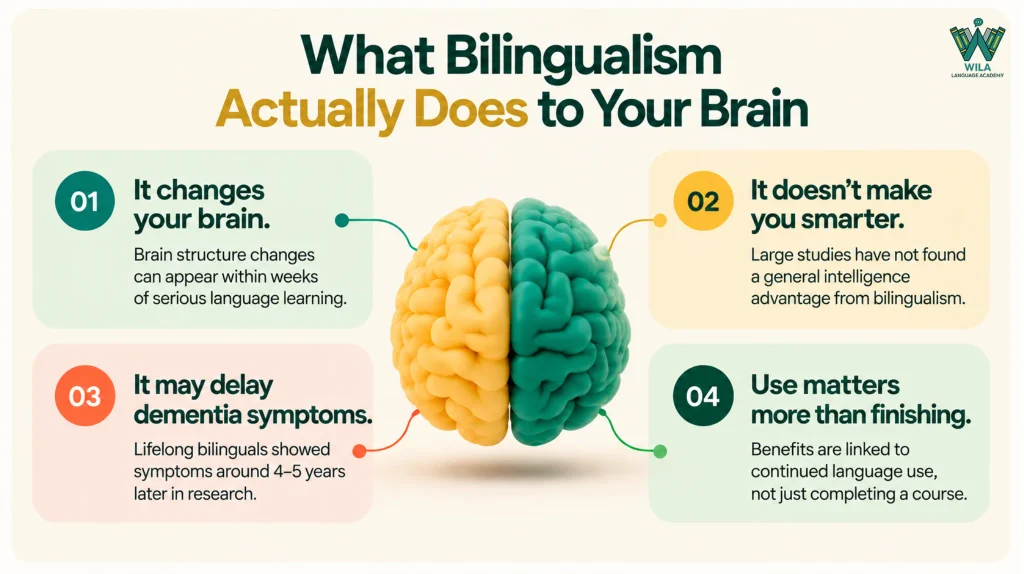
Learning and using a second language changes the structure of your brain within a few weeks, and people who use two languages for most of their lives tend to show dementia symptoms around four to five years later than people who use one. It does not make you generally smarter or better at multitasking.
| What people claim | What people claim |
|---|---|
| It makes you smarter | Not supported in large studies of adults |
| It improves multitasking | Tested in 11,000 people and not found |
| It changes your brain physically | Supported, and visible within weeks |
| It delays dementia symptoms | Supported, by about four to five years |
| A course alone gives you these benefits | No. Long-term use of the language is what the studies measured |
What does learning a second language do to your brain?
The most immediate of the benefits of bilingualism is physical, because learning a language changes the parts of your brain that handle words and memory, and the change starts early in the process.
The clearest example comes from army interpreters in Sweden. They spent three months learning Dari, Russian or Arabic from scratch, full time. Brain scans taken before and after showed that several areas had grown, including the hippocampus, which is the part you use to store new memories. Students on other demanding courses were scanned over the same period and showed no similar growth (Mårtensson et al., NeuroImage, 2012).
Similar changes have been found in ordinary learners after a few weeks of serious vocabulary work, and bilingual people carry denser tissue in the area of the brain used for handling words (Mechelli et al., Nature, 2004).
There is a condition attached. A 2026 review found that in at least one study, the changes had faded a year later in learners who stopped practicing (Alghamdi, Frontiers in Human Neuroscience, 2026), so your brain responds to what you are doing now rather than to a course you finished once.
Does being bilingual make you smarter?
No, and this is the most common mistake in articles about the cognitive benefits of languages.
For years the benefits of bilingualism were said to include better focus, better multitasking and a stronger ability to ignore distractions. A study of more than 11,000 people tested it properly. The bilingual group did better on one task, the single-language group did better on four, and every difference disappeared once the researchers accounted for age and education (Nichols et al., Psychological Science, 2020).
The myth spread because of which results got published. Across thirteen years of conference studies, those showing a bilingual advantage were published roughly six times out of ten, while those showing no advantage were published roughly three and a half times out of ten (de Bruin, Treccani and Della Sala, Psychological Science, 2015).
How does bilingualism protect your brain as you get older?
The longest-lasting of the benefits of bilingualism is a buffer, which means your brain can absorb more damage before that damage causes problems you notice.
Two studies from Hyderabad show this more clearly than anything else in the field. In most countries bilingual people are often immigrants, so better health outcomes might come from income or education rather than language, but in Hyderabad using three languages in a day is normal for everyone, which lets the language effect be measured on its own.
| Study | What it found |
|---|---|
| 648 dementia patients, Hyderabad | Bilingual patients showed symptoms at about 65, single-language patients at about 61 (Alladi et al., Neurology, 2013) |
| 608 stroke patients, Hyderabad | 4 in 10 bilingual patients kept normal thinking and memory after the stroke, against 2 in 10 of the others (Alladi et al., Stroke, 2015) |
| 40 Alzheimer’s patients, Canada | At the same test scores, the bilingual patients’ scans showed more damage (Schweizer et al., Cortex, 2012) |
The last row explains the buffer best: two patients score the same on the same test, but the bilingual patient’s scan looks worse because the illness had progressed further before it started to show. The limit matters though, because this delays when problems appear rather than preventing the illness, and no language course can promise any of it.
Is it too late to start learning a language after 30?
No, the research on adult learners is reasonably encouraging, though it is smaller than the research on lifelong bilinguals.
A group of Scottish people tested as eleven-year-olds in 1947 were retested sixty years later. Because their childhood scores existed, researchers could check whether the bilingual ones beat their own earlier results, and they did, including people who had learned their second language as adults (Bak et al., Annals of Neurology, 2014). A large 2025 study across 27 European countries pointed the same way, finding that people who spoke only one language were more likely to show signs of ageing faster than their years (Nature Aging, 2025).
Starting in your thirties is late for sounding like a native speaker, but not for the benefits of bilingualism described above.
| Lifelong bilingual | Adult who keeps learning | |
|---|---|---|
| Brain structure changes | Yes | Yes, while actively learning |
| General intelligence boost | No | No |
| Later dementia symptoms | Strong evidence | Some evidence, less certain |
| What it depends on | Daily use over decades | Whether you keep using the language |
What do you give up by choosing an English-speaking country?
You give up more than the benefits of bilingualism, and those are the smallest item on the list.
Every study above measured people doing something difficult on purpose over a long period, so there is no version of this where the benefits of bilingualism arrive without the work. Skipping that work usually costs you other things too.
- The countries where your particular field is strongest may not be English-speaking ones
- Public universities in Germany and France often cost far less than private options in English-speaking countries
- Roles that involve a local market usually need the local language, whatever the job advert says about English
- Most people in India already handle two or three languages daily, so a fourth is a smaller step than it appears
How much practice do you need for the benefits to last?
Whether the benefits of bilingualism last comes down to practice, and around five hours a week of active use is the only figure in this research attached to a result that survived.
Researchers ran a one-week Scottish Gaelic course of about fourteen hours with learners aged 18 to 78. Straight afterwards the learners had improved at switching attention between tasks, while people on other week-long courses had not. Nine months later, the improvement had survived only in learners still using Gaelic for five or more hours a week (Bak, Long, Vega-Mendoza and Sorace, PLOS ONE, 2016).
What that means in practice:
- Count only the time you spend speaking, listening or reading, not the time an app sits open on your phone
- Speak with other people as often as you can, since conversation is closest to how bilingual people actually use language
- Move up a level once the current one feels comfortable, because the research measured effortful learning rather than revision
- Choose a schedule you can keep for a year, since consistency mattered far more than how intensively anyone started
How WILA Languages can help
If the benefits of bilingualism depend on whether you are still learning in a year, the problem to solve is structure rather than motivation.
WILA Languages runs live online classes with an instructor and a fixed weekly schedule through CEFR levels A1 to C2, instead of handing you recordings to work through alone. A class at a set time, a teacher who notices when you go quiet, classmates at your level and a next level to move up to are the conditions under which people are still using the language nine months later.
One thing we will not claim: no language course, including ours, prevents or delays dementia. That research covers people who lived in two languages for decades, not people who enrolled in a course.
Conclusion
The benefits of bilingualism are real, but slower and quieter than the internet version suggests. You get physical changes in your brain while you are actively learning and a buffer that may delay memory problems decades later, but you do not get a general boost to intelligence or focus. The decision worth making is which language your life will actually push you to use, and which way of learning will still have you showing up next winter.
FAQs
1.Which language gives the most benefits of bilingualism?
The benefits of bilingualism come from using a language often rather than from which language you pick, so choose based on where you want to work, study or live. German, French and Spanish are the most common choices for Indian learners because of study and work routes in Europe.
2. Do language apps count as practice?
Partly. Apps are useful for vocabulary and daily contact with the language, but a fifteen-minute streak is not the level of effort these studies measured. Use an app alongside classes rather than instead of them.
3. I already speak three languages. Does a fourth add anything?
The evidence is split. The Hyderabad dementia study found no extra benefit beyond two languages, while the 2025 European study found protection increasing with each additional language. Choose a fourth language for practical reasons rather than for your brain.
4. Will learning a language improve my memory in general?
No. You will get noticeably better at remembering things in that language, but a general memory improvement is not supported by the evidence.







