

Planning to study in Germany can get confusing once you start comparing university requirements. There is no single German Language Requirement that applies to every international student. Your requirement depends mainly on your programme’s teaching language, the level of proficiency it requires, the certificate it accepts, and when you need to submit proof.
A German-taught programme may require B2 or C1 German, while an English-taught programme may ask for IELTS, TOEFL or another accepted qualification. Some universities may also accept alternative proof of language ability.
The safest approach is simple: find your exact programme first, then work backwards from its language requirement.
German Language Requirements for German-Taught Programmes
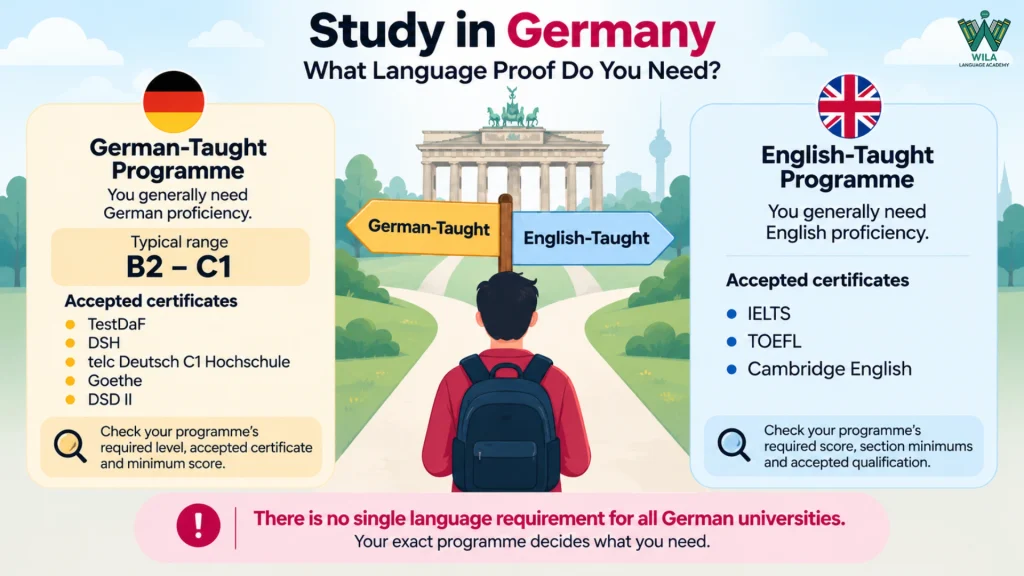
If your degree is taught in German, you will generally need to prove your German proficiency.
Many German higher education institutions use B2 CEFR or above as a general reference point, but this is not a Germany-wide minimum. Some programmes require C1, while others may specify a particular examination or allow conditional admission.
For university applicants, the CEFR levels most relevant to this discussion are B1 to C2:
| Level | What it generally indicates |
|---|---|
| B1 | Can handle familiar situations and straightforward communication |
| B2 | Can understand complex language and participate in discussions |
| C1 | Can communicate effectively in demanding academic and professional contexts |
| C2 | Can understand and express highly complex language with precision |
For university study, the level alone is not enough. You also need to know which certificate and result your programme accepts.
For example, a B2 qualification may be sufficient for one programme but not another that requires C1. This is why “What level of German do I need?” is only the first question. The next one is: “Which proof does my university accept?”
Which German Certificate Do You Need?
To meet the German Language Requirement, German universities may accept qualifications such as TestDaF, DSH, telc Deutsch C1 Hochschule, Goethe certificates or DSD II. However, acceptance and minimum results can vary by institution and programme.
For example, official Study in Germany guidance states that TestDaF TDN 4 in all four sections or DSH-2 generally provides unrestricted admission, while some programmes may accept different results or conditions.
| Certificate | What to check |
|---|---|
| TestDaF | Required TDN result in each section |
| DSH | Whether DSH-2 or another result is required |
| telc Deutsch C1 Hochschule | Whether the programme accepts this certificate |
| Goethe | Which Goethe certificate and level is accepted |
| DSD II | Whether it meets the programme’s admission requirement |
Do not book an exam simply because it is widely recognised. Check the university’s accepted certificates first.
Previous education can also affect what proof you need. Some universities may recognise German-language education, specific qualifications or other evidence instead of requiring a separate language examination. Similarly, students who have completed previous education in English may sometimes qualify for an exemption from an English-language test.
These exemptions are not automatic. Check the programme’s requirements before assuming that your previous education will be accepted.
What If You Need a Studienkolleg?
Students whose school-leaving qualification does not provide direct university admission may need to complete a Studienkolleg first.
Because Studienkolleg courses are taught in German, applicants generally need German at around B1–B2 for admission and may also need to pass an entrance examination. Requirements can differ between institutions, so check the specific Studienkolleg before applying.
This makes language preparation particularly important if you need a Studienkolleg. You may need to meet its language requirement before reaching the language level required by your eventual degree programme.
English Requirements for English-Taught Programmes
If your programme is taught in English, you will generally need to demonstrate English proficiency rather than German.
There is no single IELTS score for studying in Germany. A programme may specify IELTS, TOEFL, Cambridge English or another qualification, and it may set a CEFR level or minimum score.
For example, one programme might accept IELTS 6.0, while another may require 6.5 or a different qualification entirely. Some universities also set minimum scores for individual test sections.
The same applies to TOEFL. Do not assume that a score accepted by one German university will automatically be accepted by another.
Your previous education may sometimes be used as evidence of English proficiency. An English-medium degree or an official Medium of Instruction (MOI) document may be accepted by some universities, while others still require a standardised test.
If you already have an English-medium degree, check the programme’s exemption rules before paying for another test.
Also check when your test result needs to be submitted. Language-test validity and university application deadlines are separate issues, so a score that is still valid in general may not solve a missed application deadline.
University Admission and the German Student Visa Are Different
One of the easiest mistakes to make is treating university admission and the German student visa as the same process.
Your university decides the German Language Requirement and language proof you need for admission. Visa requirements are handled separately and can depend on factors such as your nationality, programme and admission status.
| Check | Where to verify it |
|---|---|
| Teaching language | University programme page |
| Required CEFR level or score | University programme page |
| Accepted certificates | University programme page |
| Exemptions | University admissions office |
| Visa documentation | German mission / Federal Foreign Office |
A language certificate may therefore be important for your university application, but meeting a university’s language requirement does not automatically mean every visa documentation requirement has been met.
Treat the two processes separately: first establish what the university needs for admission, then check the current visa requirements for your situation.
Do You Need German for an English-Taught Degree?
Usually not for admission to an English-taught programme when you have the required English proof.
That does not make German irrelevant. Basic German can make everyday life easier and may be useful when dealing with situations outside the university, including local communication and some part-time work situations.
So there are two different questions:
Do I need German to get admitted?
Check the language requirements for your programme.
Will German be useful while I live in Germany?
For many international students, learning some German can make daily life easier.
Keeping these questions separate prevents a common misunderstanding: a student may not need German for admission but may still benefit from learning it before or after moving to Germany.
How to Check Your Exact Language Requirement
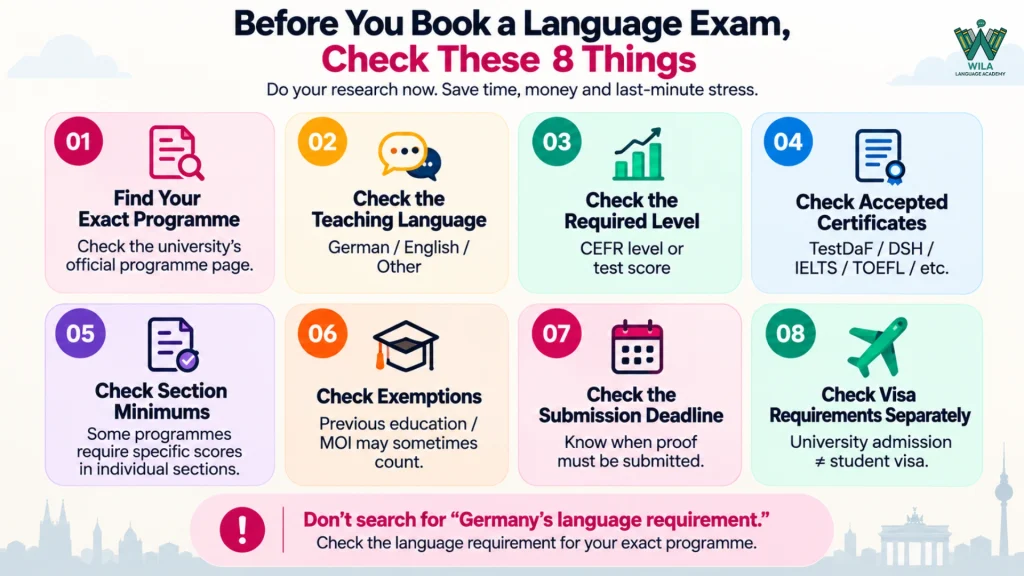
Before choosing a language exam, work through this checklist:
- Find your exact degree programme on the university’s official website.
- Confirm whether it is taught in German, English or another language.
- Check the required CEFR level or test score.
- Check which certificates the programme accepts.
- Look for minimum scores in individual test sections.
- Check whether previous education or an MOI can replace a standardised test.
- Confirm when the language certificate must be submitted.
- Check the latest visa requirements separately with the responsible German mission.
If you are still unsure, contact the university’s admissions or international office rather than relying on a requirement listed for another programme.
This approach is much safer than searching for a general “German Language Requirement for Germany” and assuming the first answer applies to your course.
Common Mistakes to Avoid
International applicants often run into problems because they:
- Assume B2 or C1 is required everywhere.
- Choose a test before checking which certificates the university accepts.
- Treat IELTS 6.5 as a Germany-wide standard.
- Assume an MOI is automatically accepted.
- Confuse admission requirements with visa requirements.
- Submit a certificate after the programme’s document deadline.
- Rely on another university’s language requirements.
Most of these mistakes come from treating general information as if it were a programme-specific rule.
The most important rule is simple: your university’s programme page is more relevant to your application than a general language requirement found online.
Learning German for Your Study Plans
If your chosen programme requires German, start with the level you actually need rather than treating C1 or C2 as the automatic goal.
A student who needs B2 for admission has a different learning target from someone whose programme requires C1. Once you know the required level and exam, you can build your preparation around that specific goal.
If you are starting from a lower level, give yourself enough time to build the underlying language skills before focusing heavily on exam technique. Your preparation should match both the proficiency level you need and the examination you plan to take.
WILA Languages offers structured German learning aligned with the CEFR framework, helping learners build their proficiency systematically and prepare for recognized German examinations.
Conclusion
There is no single German Language Requirement for studying in Germany. The right requirement depends on your programme, teaching language, required proficiency level, accepted certificate and submission deadline.
Start with the exact degree programme, confirm its language requirements, and then choose the appropriate certification or exemption. Check admission and visa requirements separately, and verify any exemption before assuming you do not need a language test.
The right starting point is not a general German language requirement, it is the language requirement for the exact programme you want to study.
Frequently Asked Questions
1. What is the German Language Requirement for studying in Germany?
The German Language Requirement for studying in Germany depends on your university, programme language, and accepted proof of proficiency. For German-taught programmes, many institutions expect German around B2 or above, while some programmes require C1 or a specific certificate.
2. Is B2 German enough to study in Germany?
B2 German can be sufficient for some German-taught programmes, but it is not a universal standard. The required level depends on individual German University Requirements, as some courses may require C1 or specific results such as DSH-2 or TestDaF TDN 4.
3. Which German certificates are accepted by German universities?
Commonly accepted certificates include TestDaF, DSH, telc Deutsch C1 Hochschule, Goethe certificates, and DSD II. Always check which qualification and result your programme accepts before applying to avoid choosing the wrong certification.
4. Can an English-medium degree replace IELTS or TOEFL?
Sometimes. Some universities accept previous English-medium education or a Medium of Instruction (MOI) document, while others require a standardised test. Check the programme’s exemption rules and German Visa requirements separately before applying.
5. Do I need German for an English-taught programme?
Generally, you do not need German for admission to an English-taught programme if you meet the required English proficiency criteria. However, learning German for Students can make daily life easier and help with communication outside the university.







