

Planning to take the IELTS exam but not sure which test to choose?
You are not alone. IELTS Academic and IELTS General Training have the same four sections, use the same IELTS Band Score system, and share the same Listening and Speaking tests. But they are designed for different goals.
Choosing the wrong test can mean losing your test fee and wasting weeks of preparation.
The good news? The choice is quite simple once you know what you need IELTS for.
In this blog, we will break down IELTS Academic vs General, compare the two tests, and help you choose the right one for your goal.
IELTS Academic vs General: The quick answer
Choose IELTS Academic if you plan to study at undergraduate or postgraduate level, or if a professional body requires Academic for registration.
Choose IELTS General Training if you need IELTS for migration, work, or study or training below degree level.
The most important rule is simple: do not choose your test based on what a friend took or which version sounds easier. Check the exact requirement of the university, employer, immigration authority, or professional body that will receive your score.
Official IELTS test-type guidance confirms that Academic and General Training are designed for different purposes, while Listening and Speaking are the same in both versions.
IELTS Academic vs General: What stays the same?
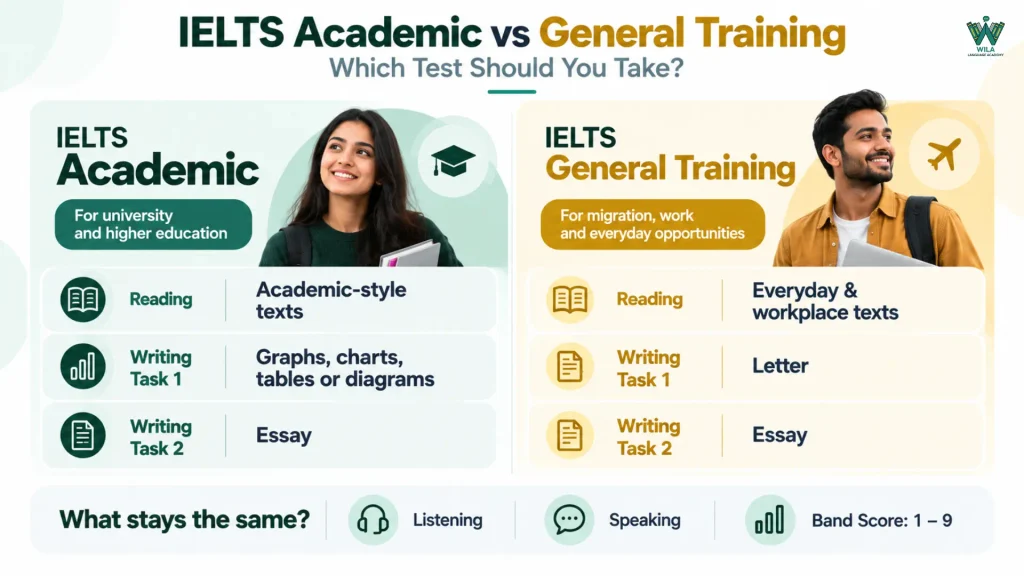
Both tests assess four English skills: Listening, Reading, Writing, Speaking.
Listening and Speaking are the same in both tests. Reading and Writing are the sections that change.
The test timings are also broadly the same. Listening runs about 30 minutes plus 10 minutes to transfer answers on paper, Reading is 60 minutes, Writing is 60 minutes, and Speaking is 11 to 14 minutes.
Both versions use the 1 to 9 IELTS Band Score scale, with whole and half bands.
So you do not need to prepare for two completely different exams. Your biggest preparation changes will be in Reading and Writing.
IELTS Academic: Who should take it?
IELTS Academic is designed for people who need English for higher education or certain professional registration routes.
You may need it if you are applying for a bachelor’s degree, applying for a master’s degree, applying for another undergraduate or postgraduate course, applying for certain professional registration routes, or planning to Study Abroad at a university that asks for IELTS Academic.
Academic Reading uses texts from books, journals, magazines, newspapers, and online resources. The texts are aimed at students entering undergraduate or postgraduate study.
Academic Writing Task 1 asks you to describe visual information such as a graph, chart, table, or diagram. You need to write at least 150 words. Task 2 is an essay of at least 250 words.
If your goal is university admission, check the institution’s exact requirement before booking your test. When you are ready to train for it, our IELTS Academic preparation track focuses on exactly these skills.
IELTS General Training: Who should take it?
IELTS General Training focuses more on practical English used in everyday life, work, and social situations.
You may need it if you are applying to migrate to an English-speaking country, applying for a job where IELTS is required, planning vocational training, or applying for study or training below degree level.
General Training Reading includes practical texts connected to everyday life and work. Section 1 can include notices, advertisements, and timetables, while Section 2 focuses on workplace topics.
Its Writing Task 1 is also different. Instead of describing a graph or chart, you write a letter based on a practical situation. Task 2 is an essay, just like in Academic. Our IELTS General Training preparation builds these everyday and workplace skills.
IELTS Academic vs General: Reading differences
Reading is one of the two sections that changes between the tests.
Academic Reading uses texts related to academic and general-interest topics. General Training Reading uses more practical material, including texts connected to everyday life and work.
Both versions have three sections, 40 questions, and 60 minutes.
The question types can overlap, but the texts are different. Academic Reading can contain more complex vocabulary and styles of writing. Official IELTS test-format guidance also indicates that a greater number of correct answers is usually needed in General Training Reading to achieve the same band, because the tests differ in difficulty.
That means you should prepare with the exact version of the Reading test you plan to take.
IELTS Academic vs General: Writing differences
Writing is where the difference becomes most obvious.
| Writing section | Academic | General Training |
|---|---|---|
| Task 1 | Describe a graph, chart, table, or diagram | Write a letter based on a situation |
| Task 1 length | At least 150 words | At least 150 words |
| Task 2 | Essay of at least 250 words | Essay of at least 250 words |
| Main difference | Academic-style description and analysis | Practical communication and appropriate letter style |
| Task 2 weight | Counts twice as much as Task 1 | Counts twice as much as Task 1 |
Both versions assess your ability to respond to the task, organize ideas, use vocabulary, and use grammar accurately. Task 2 carries twice the weight of Task 1.
This is why practicing the wrong Writing Task 1 is a serious mistake. Academic and General Training require different approaches.
IELTS Academic vs General: Quick comparison
| Academic | General Training | |
|---|---|---|
| Best for | University study, including bachelor’s and master’s programmes, and some professional registration | Migration, work, and study or training below degree level |
| Reading | Academic-style texts with more complex language and arguments | Everyday, workplace, and general-interest texts |
| Writing Task 1 | Graphs, charts, tables, or diagrams | Formal, semi-formal, or personal letter |
| What stays the same | Listening, Speaking, 40-question Listening and Reading sections, 1 to 9 scoring system | Listening, Speaking, 40-question Listening and Reading sections, 1 to 9 scoring system |
| Best preparation focus | Academic Reading, data description, essays, and all four skills | Practical Reading, letter writing, essays, and all four skills |
The simplest way to remember it is this. Academic is built around higher education and professional registration, while General Training is built around practical English for migration, work, and below-degree study.
Which test is easier? (IELTS Academic or General)
There is no official “easy” version.
Some people find General Training Reading more comfortable because the texts are closer to everyday situations. Others may prefer Academic Reading because they are already used to academic material.
The same applies to Writing. Your strengths can make one version feel easier than the other.
But difficulty should not decide your test.
Acceptance matters more. If your university requires Academic, taking General Training because it seems easier will not help your application.
How to choose the right IELTS test
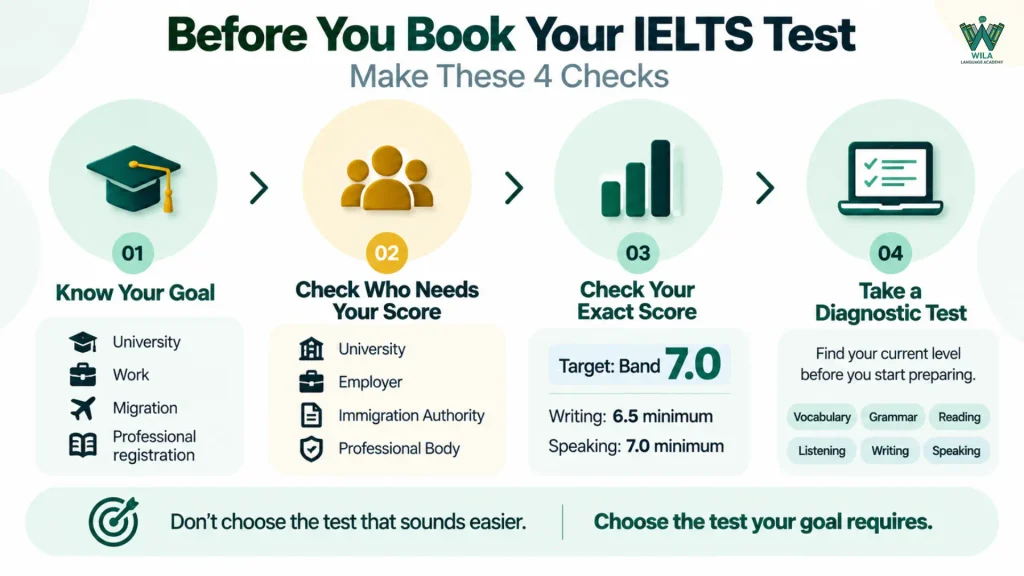
Use these four checks before you book.
1. Start with your goal
Are you going to university? Looking to migrate? Applying for work? Pursuing professional registration? Your goal will usually point you towards the right test.
2. Check who needs your score
Find the exact organization that will receive your IELTS result. For a student, this may be a university. For a migrant, it may be an immigration authority. For a professional, it may be a registration body.
3. Check the exact score requirement
Do not stop at “IELTS 7.” Some organizations also set minimum scores for individual sections. You may need a specific minimum in Writing or Speaking as well as a required overall score. Write down the exact target before you begin preparation.
4. Take a diagnostic test
Before spending weeks on IELTS Preparation, find out where you stand. A practice test can show whether your main problem is vocabulary, grammar, reading speed, listening accuracy, writing structure, or speaking fluency. That gives you a much better starting point than simply doing random IELTS questions every day. You can book a free diagnostic IELTS test to see your current band before you start.
How IELTS Coaching can help
Knowing which test to take is only the first step. Getting the required score is the real challenge.
Good IELTS Coaching should do more than provide tips and model answers. It should identify where you are losing marks and give you a clear plan to improve.
At WILA Languages, structured IELTS Preparation can help you identify your current level and target score, practice the correct Academic or General Training format, get feedback on Writing and Speaking, improve time management, track repeated mistakes, and prepare through regular mock tests.
The goal is simple. Spend your preparation time fixing the problems that are actually holding your score back.
Final takeaway
Comparing IELTS Academic vs General is not about finding the easier test. It is about choosing the test that matches your goal and is accepted by the organization receiving your score.
Check the requirement first, set your target IELTS Band Score, and then build your preparation around the exact test you need. If you want a structured start, explore our WILA Languages IELTS preparation course with both Academic and General Training tracks.
Frequently Asked Questions
1. How rare is an 8.5 in IELTS?
An 8.5 is a very high IELTS Band Score and represents a very strong command of English. But rarity is less important than your required score. If your university or visa route needs 7.0, there is little reason to chase 8.5 unless you have another specific goal.
2. What is 7.5 IELTS equivalent to?
IELTS 7.5 is between Band 7 and Band 8 on the IELTS 9-band scale. There is no single universal equivalent across other English tests, so use the score comparison accepted by the university, employer, or authority you are applying to.
3. Is 6.25 rounded to 6.5 in IELTS?
Yes. Your overall IELTS score is the average of your four section scores. If that average ends in .25, it is rounded up to the next half band. For example, an average of 6.25 becomes 6.5. An average of 6.75 becomes 7.0.
4. Which IELTS test is difficult: IELTS Academic vs General?
Neither is officially labelled as the difficult version. Academic Reading generally contains more complex academic-style material, while General Training Reading is more practical. Your experience will depend on your English level and the type of material you are comfortable with.
5. Is IELTS General easier than Academic?
It can feel easier to some test takers, especially in Reading, because General Training uses more everyday and workplace-based texts. But the two tests have different purposes, so choosing General simply because it seems easier is the wrong approach.
6. IELTS Academic or General for university?
For most undergraduate and postgraduate university applications, IELTS Academic is the relevant test. Always check your university and course requirements before booking.
7. IELTS Academic vs General for a master’s degree?
IELTS Academic is generally the version used for master’s applications because it is designed for postgraduate and undergraduate study. Your university may also set its own overall and section-wise score requirements.







