
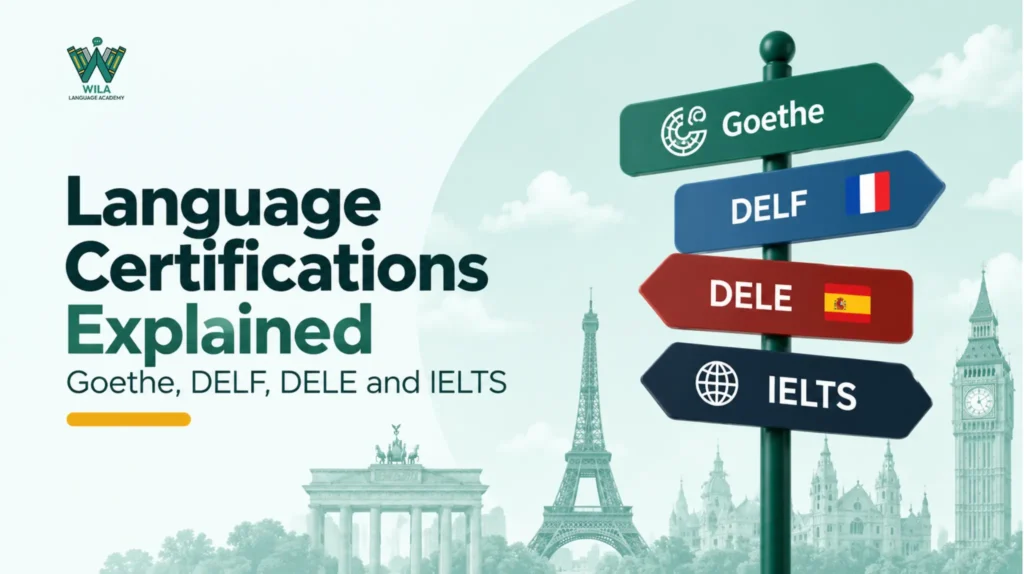

Where you want to go abroad can determine how you need to prove what you know. Language Certifications are how universities, employers and immigration authorities verify that proof.
Planning to study in Germany? Your university may ask for German proficiency. Moving to France? You may need recognized proof of French. Applying for a programme in Spain? Spanish certification could matter. And for many international study and migration routes, English proficiency may be assessed through IELTS.
The important thing is that there is no universal language certificate. Language Certifications differ by country, language and issuing body.
Here is how Goethe, DELF/DALF, DELE and IELTS work, and how to identify the one that fits your next move.
Language Certifications: Which One Is for You?
The simplest way to start is with the language you need to prove.
| If you need to prove | Certification | Language | Scale |
|---|---|---|---|
| German | Goethe-Zertifikat | German | A1 to C2 |
| French | DELF / DALF | French | A1 to C2 |
| Spanish | DELE | Spanish | A1 to C2 |
| English | IELTS | English | Band 1 to 9 |
The first three use CEFR Levels, while IELTS reports English proficiency through band scores. So an IELTS 7.0, for example, is not the same type of result as a B2 Goethe Certificate.
Your next step is to check which certification and level or score your university, employer or immigration authority actually accepts.
German: Goethe-Zertifikat
The Goethe-Zertifikat is the main certification to consider if you need official proof of German proficiency. The Goethe-Institut offers exams from A1 for beginners to C2 for highly advanced German.
| What you need to know | Goethe-Zertifikat |
|---|---|
| Language | German |
| Issuing body | Goethe-Institut |
| Levels | A1 to C2 |
| Skills tested | Reading, Listening, Writing, Speaking |
| Validity | Does not expire |
| Common uses | Study, work, visa procedures, professional recognition |
| Beginner level | Goethe A1 |
| Higher levels | Goethe B1, B2, C1, C2 |
| Important point | The required level depends on the institution or purpose |
Goethe certificates are internationally recognized as proof of German proficiency, including for certain visa procedures, professional recognition and university admission. However, the accepted level varies by requirement.
The certificate itself does not expire, although some institutions and employers may ask for a certificate issued within the last two years.
Choose Goethe if German is the language you need to certify and the organization you are applying to accepts the Goethe-Zertifikat. You can review the official Goethe-Institut German exams for level details.
French: DELF and DALF
For French, the certification system is split between DELF and DALF.
DELF covers the beginner to upper-intermediate levels, while DALF covers the two highest CEFR Levels.
| What you need to know | DELF / DALF |
|---|---|
| Language | French |
| Issuing body | France Éducation international |
| Levels | DELF: A1 to B2; DALF: C1 to C2 |
| Skills tested | Reading, Listening, Writing, Speaking |
| Validity | Diploma valid for life |
| Common uses | Study, work and official French-language requirements |
| Beginner level | DELF A1 |
| Advanced level | DALF C1/C2 |
| Important point | DELF and DALF together cover A1 to C2 |
So the choice within the French system is straightforward. If your target is A1 to B2, look at DELF. If you need C1 or C2 certification, look at DALF.
Choose DELF/DALF if you need official proof of French proficiency and the organization accepts the relevant French Certification. Full details are on the France Éducation international DELF and DALF pages.
Spanish: DELE
DELE stands for Diploma de Español como Lengua Extranjera. It is the official Spanish language diploma issued by Instituto Cervantes on behalf of Spain’s Ministry of Education.
| What you need to know | DELE |
|---|---|
| Language | Spanish |
| Issuing body | Instituto Cervantes |
| Levels | A1 to C2 |
| Skills tested | Reading, Listening, Writing, Speaking |
| Validity | Indefinite |
| Common uses | Study, work and certain official processes |
| Beginner level | DELE A1 |
| Highest level | DELE C2 |
| Important point | The diploma certifies a specific CEFR level |
DELE gives you a formal qualification tied to a particular proficiency level. It is available across the full A1 to C2 range, so you can take the examination that matches your ability and requirement.
The diploma has indefinite validity.
Choose DELE if Spanish is the language you need to certify and you need a recognised Spanish diploma rather than a course-completion certificate. You can check level requirements on the Instituto Cervantes DELE pages.
English: IELTS
IELTS works differently from the three certifications above. As an English Proficiency Test, it reports a score rather than a fixed CEFR certificate, so it is a Language Proficiency Test measured on its own scale.
Instead of receiving an A1 to C2 certificate, you receive a band score from 1 to 9. IELTS assesses Listening, Reading, Writing and Speaking.
| What you need to know | IELTS |
|---|---|
| Language | English |
| Test | IELTS |
| Score | Band 1 to 9 |
| Main versions | Academic, General Training |
| Skills tested | Listening, Reading, Writing, Speaking |
| Common uses | Higher education, work, professional registration, migration |
| Validity | Generally treated as 2 years |
| Important point | It uses a band score, not an A1 to C2 certificate |
IELTS Academic is mainly designed for higher education and some professional registration purposes, while IELTS General Training is commonly used for migration, work and other contexts.
IELTS also uses its own scoring system. CEFR comparisons can help provide context, but IELTS bands and CEFR Levels are not one-to-one equivalents.
Choose IELTS if you need to demonstrate English proficiency and the institution, employer or immigration route accepts IELTS. You can review the official IELTS test types before you register.
Language Certifications Compared: Goethe vs DELF vs DELE vs IELTS
Now that you know what each certification does, here is the comparison in one place.
| Goethe | DELF / DALF | DELE | IELTS | |
|---|---|---|---|---|
| Language | German | French | Spanish | English |
| Issuing body | Goethe-Institut | France Éducation international | Instituto Cervantes | IELTS |
| Scale | A1 to C2 | A1 to C2 | A1 to C2 | Band 1 to 9 |
| Beginner entry | A1 | DELF A1 | DELE A1 | Depends on required score |
| Highest level | C2 | DALF C2 | C2 | Band 9 |
| Four skills | Yes | Yes | Yes | Yes |
| Validity | No expiry | Valid for life | Indefinite | Generally 2 years |
| Main uses | Study, work, official requirements | Study, work, official requirements | Study, work, official processes | Study, work, migration |
The key difference is not simply the language.
Goethe, DELF/DALF and DELE certify proficiency at a defined CEFR level. IELTS gives you an English proficiency score that can be used to meet a specific score requirement.
What Do A1 to C2 Actually Mean?
Most Language Certifications, including Goethe, DELF/DALF and DELE, report results against the CEFR Levels, which provide a common reference point.
| Level | What it broadly means |
|---|---|
| A1 | You can handle very basic communication. |
| A2 | You can manage familiar, everyday situations. |
| B1 | You can communicate independently in many everyday situations. |
| B2 | You can discuss more complex subjects with reasonable confidence. |
| C1 | You can use the language effectively in demanding academic or professional situations. |
| C2 | You have a very high level of proficiency. |
The important thing is that your level should match your actual goal.
You do not need C1 simply because it is a higher level. If a programme asks for B2, preparing specifically for B2 makes more sense than taking a higher exam without a reason.
How to Choose the Right Language Certification
Use this four-step check before booking any test.
1. Start with the language
German points to Goethe, French points to DELF/DALF, Spanish points to DELE, and English points to IELTS.
2. Identify your purpose
Are you taking the test for university admission, a job, professional registration, immigration or personal proof of proficiency? Your purpose can determine which test version or level you need.
3. Check the exact requirement
This is the most important step. Find out which certification is accepted, what level or score is required, whether the result needs to be recent, and whether there are any additional requirements. Do not assume that every university or employer accepts every certification.
4. Prepare for the specific exam
Once you know the certification and target level, prepare for its actual format. Learn the question types, practice all four skills, use official sample material and complete timed tests. The goal is not just to know the language. You need to be able to demonstrate your ability in the format you will be tested on.
What to Check Before You Book
Language Certifications are not interchangeable, so before paying for an exam, run through this quick checklist:
- Language: Am I taking the test for the right language?
- Certification: Does my university, employer or authority accept this specific test?
- Level or score: What exact level or score do I need?
- Validity: Does the organization have a deadline or recent-result requirement?
- Test version: If there are different versions, am I registering for the right one?
A few minutes of checking can prevent you from taking an exam that does not meet your actual requirement.
Final Takeaway
Choosing a language certification is less about finding the “best” exam and more about finding the right match.
German points to Goethe. French points to DELF/DALF. Spanish points to DELE. English points to IELTS.
Once you know your goal and the exact requirement, you can choose the right level, prepare for the right format and avoid unnecessary testing.
If you are building your German, French or Spanish skills before taking a certification exam, WILA Languages can help you develop your language proficiency through structured, level-based learning.
Frequently Asked Questions
1. What are Language Certifications?
Language Certifications are official assessments that verify your ability to read, write, listen, and communicate in a specific language. These certifications provide recognized proof of language proficiency for purposes such as higher education, employment, immigration, and professional requirements.
2. Which Language Certification is best for German?
The Goethe-Zertifikat is one of the most recognized Language Certifications for German proficiency. It is available from A1 to C2 levels, and the right certification level depends on your academic, professional, or immigration requirements.
3. What is the difference between DELF and DALF Language Certifications?
DELF and DALF are French Language Certifications based on the CEFR framework. DELF covers levels A1 to B2, while DALF is designed for advanced learners at C1 and C2 levels. Together, they provide French proficiency certification across the complete CEFR range.
4. Is DELE a valid Language Certification for life?
Yes. DELE is a Spanish Language Certification with indefinite validity. Once awarded, the diploma does not expire, although specific institutions or organizations may have their own requirements when accepting language qualifications.
5. Is IELTS considered a Language Certification like Goethe, DELF, or DELE?
IELTS is an English proficiency test that works differently from many Language Certifications. Instead of CEFR levels from A1 to C2, IELTS provides a band score from 1 to 9. Institutions use the required IELTS score based on their admission, work, or migration criteria.
6. Which Language Certification should I choose for studying abroad?
The right Language Certification depends on your destination country, course requirements, and the language of instruction. For example, German universities may require Goethe certification, French institutions may accept DELF/DALF, Spanish programmes may require DELE, and many English-speaking destinations accept IELTS.
7. Do Language Certifications expire?
The validity of Language Certifications depends on the specific exam. Goethe-Zertifikat and DELE diplomas generally do not expire, while IELTS results are usually considered valid for two years. However, universities, employers, and authorities may have their own recent-result requirements.







