
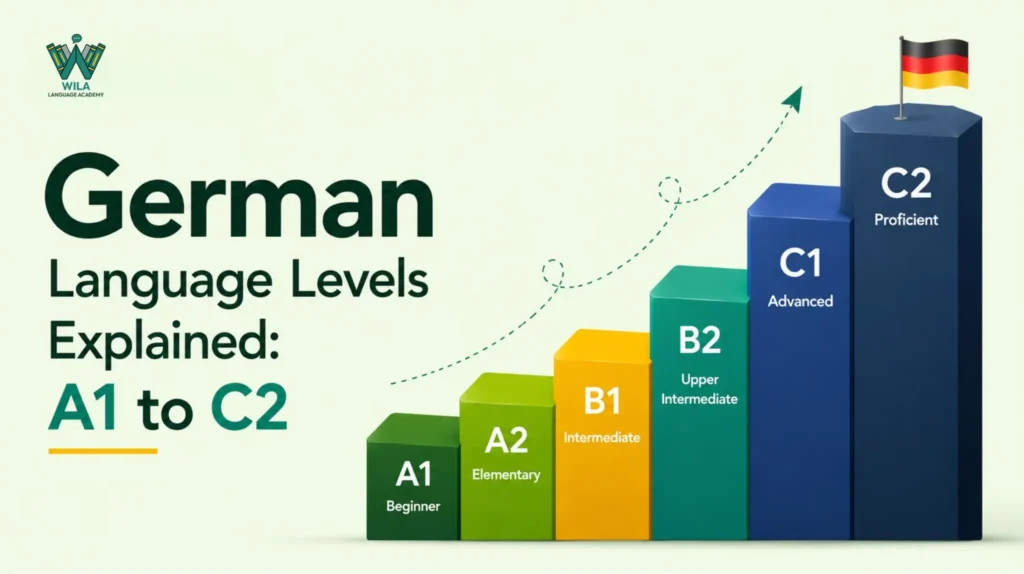

If you are planning to learn German, you will quickly come across terms such as A1, A2, B1, B2, C1 and C2.
These are not different courses or types of German. They are the six proficiency levels used by the Common European Framework of Reference for Languages (CEFR) to describe how well someone can understand and use a language.
For Indian students and professionals, German has become increasingly relevant. In the winter semester 2025/26, a record 69,816 Indian students were enrolled at German higher-education institutions, making India the largest group of international students in the country, up 17.5% on the previous year, according to DAAD (up from 59,419 the year before).
Indian participation in the German workforce has grown too. A 2025 analysis by the German Institute for International and Security Affairs (SWP), using official German statistics, reported that at the start of 2025 around 280,000 Indian nationals were living in Germany as permanent residents, with more than 152,000 in employment subject to social-insurance contributions.
But learning German is not simply about reaching the highest possible level. If you want to study, work or live in Germany, the important question is: which German language level do you actually need?
This guide breaks down German levels from A1 to C2, explains what you can realistically do at each stage, compares B1 and B2, looks at German requirements for studying and working in Germany, explains the major language exams, and gives you a practical way to decide your target level.
German Language Levels at a Glance
The six German language levels follow the CEFR framework and are divided into three broad categories: A1 to A2 (Basic User), B1 to B2 (Independent User), and C1 to C2 (Proficient User). Here is what the progression looks like.
| German Level | CEFR Category | What It Generally Means |
|---|---|---|
| A1 | Basic User | Understand and use very basic expressions and handle simple interactions |
| A2 | Basic User | Communicate in routine situations involving familiar topics |
| B1 | Independent User | Handle many everyday situations and express experiences, plans and opinions |
| B2 | Independent User | Communicate more fluently and discuss complex topics |
| C1 | Proficient User | Use German effectively and flexibly in academic and professional situations |
| C2 | Proficient User | Understand and express complex language with a very high degree of precision |
The CEFR is based on what learners can actually do with a language, rather than simply counting grammar rules or vocabulary words. Someone may know a large amount of German vocabulary but still struggle to communicate naturally. Your CEFR level is ultimately about your ability to use the language across different situations.
A1 German: The Beginner Level
A1 is the starting point for most people who have no previous knowledge of German. At this stage, you learn the foundations: basic vocabulary, simple sentence structures, pronunciation and everyday expressions.
The goal is not to hold long conversations. Instead, you should be able to communicate when the situation is simple and the other person speaks clearly and slowly.
At A1, you can generally:
- Introduce yourself and other people
- Give basic personal information
- Ask and answer simple questions
- Understand familiar everyday expressions
- Talk briefly about basic topics such as where you live or people you know
- Handle very simple interactions
A1 in simple terms: “I can start communicating in German.”
It is a foundation, not a level of independence. You will still find normal-speed conversations and unfamiliar subjects difficult.
A2 German: Basic Everyday Communication
A2 takes you beyond memorised phrases and into routine everyday communication. At this level, you can understand frequently used expressions related to areas such as family, shopping, work, local surroundings and everyday activities, and communicate in simple exchanges involving familiar information.
For someone living in a German-speaking environment, this can make daily interactions considerably easier. You can talk about your routine, describe your surroundings and deal with straightforward situations without depending entirely on English. Communication is still limited when conversations become fast, abstract or unfamiliar.
At A2, you can generally:
- Discuss familiar everyday topics
- Describe your background and immediate surroundings
- Handle routine conversations
- Understand common expressions
- Communicate in simple situations involving familiar information
A2 in simple terms: “I can manage basic everyday German.”
B1 German: Functional Independence
B1 is an important transition point because you begin moving from basic communication towards independent use of German. You can understand the main points of clear standard language on familiar matters and deal with many situations that arise in everyday life. You can also describe experiences, events, dreams and ambitions, and give simple explanations for your opinions and plans.
You are no longer restricted to short exchanges. You can talk about something that happened to you, explain what you want to do next month, or discuss a familiar issue. You will still struggle with very fast speech, specialised terminology and complex discussions.
At B1, you can generally:
- Talk about experiences and future plans
- Express opinions on familiar subjects
- Give simple reasons for your views
- Deal with many everyday situations
- Understand the main points of clear conversations and texts
- Communicate more independently while travelling or living in a German-speaking environment
B1 in simple terms: “I can function in German.”
B2 German: Confident Independent Communication
B2 represents a significant step up from B1. You can understand the main ideas of more complex texts, including technical discussions related to your area of knowledge, and communicate with greater fluency and spontaneity. This is where German becomes much more useful for professional and academic environments.
A B2 learner can discuss advantages and disadvantages, build an argument, explain a position and participate in broader conversations without constantly searching for basic words. You may still make mistakes; B2 does not mean perfect German. But you have considerably more independence.
At B2, you can generally:
- Understand complex texts on familiar subjects
- Follow discussions related to your area of expertise
- Explain opinions clearly and in detail
- Discuss advantages and disadvantages
- Communicate with native speakers with greater spontaneity
- Participate more confidently in professional or academic discussions
B2 in simple terms: “I can communicate independently across a wide range of situations.”
C1 German: Advanced Academic and Professional German
C1 is where German becomes a highly capable language for academic, professional and complex social situations. The CEFR describes C1 users as being able to understand demanding, longer texts, recognise implicit meaning and express themselves fluently and spontaneously, using German flexibly and effectively for social, academic and professional purposes.
At C1, you should be able to participate in complex discussions without constantly simplifying what you want to say, and adapt your language depending on the situation, whether you are giving a presentation, in a professional meeting or discussing an academic subject.
At C1, you can generally:
- Understand demanding and lengthy texts
- Follow implied meanings
- Communicate fluently and spontaneously
- Present complex ideas clearly
- Adapt your language to professional and academic situations
- Write detailed and structured texts
C1 in simple terms: “I can use German effectively in serious academic and professional settings.”
C2 German: Very High Proficiency
C2 is the highest CEFR level. At this stage, the focus shifts from basic competence to precision, nuance and flexibility. A C2 user can understand almost everything they hear or read, summarize information from different sources and express themselves fluently and precisely, including when discussing complex subjects.
C2 does not mean that you must sound exactly like a native speaker in every situation. Native speakers themselves have different regional accents, vocabulary and communication styles. Instead, C2 represents an exceptionally high level of functional proficiency.
At C2, you can generally:
- Understand complex spoken and written German
- Summarize information from multiple sources
- Express complex ideas precisely
- Recognize subtle differences in meaning
- Communicate fluently across demanding situations
C2 in simple terms: “I can use German with a very high degree of precision and nuance.”
For most people learning German for work, study or relocation, however, C2 is not necessary.
German A1 to C2: What Changes as You Progress?
The progression can be understood as a gradual shift from basic survival communication to increasingly independent and precise communication.
| Level | Your ability is roughly moving towards… |
|---|---|
| A1 | Basic phrases and simple interactions |
| A2 | Routine everyday communication |
| B1 | Functional independence |
| B2 | Confident independent communication |
| C1 | Advanced academic and professional communication |
| C2 | Highly precise and nuanced communication |
The important transition happens between the three groups. A1 to A2, you are learning to manage familiar situations. B1 to B2, you are becoming an independent user of German. C1 to C2, you are developing advanced proficiency for demanding situations. This is why simply saying “I want to become fluent in German” is not specific enough. You need to define what you want to do with German first.
B1 vs B2 German: What’s the Difference?
For many learners, B1 vs B2 is the most important comparison. Both are classified as Independent User levels, but B2 gives you significantly more range and independence.
| Skill | B1 German | B2 German |
|---|---|---|
| Conversation | Familiar subjects and everyday situations | Broader, more complex discussions |
| Opinions | Simple opinions and reasons | Build arguments, explain viewpoints |
| Listening | Main points of clear standard speech | Follow more complex discussions |
| Reading | Straightforward texts on familiar topics | Complex texts, including technical material |
| Speaking | Functional, may need time to formulate | More fluent and spontaneous |
| Writing | Connected writing on familiar subjects | Clearer, detailed, structured texts |
| Overall | Functional independence | Strong independent communication |
The difference is not simply that B2 means more vocabulary. B2 gives you a much greater ability to handle complexity, which matters when German becomes part of your academic or professional life.
Which German Language Level Do You Need?
There is no single German level that everyone needs. Your target should depend on your purpose.
| Your Goal | Level to Consider | What to Keep in Mind |
|---|---|---|
| Starting German | A1 | Suitable for complete beginners |
| Basic everyday communication | A2 | Useful for routine situations |
| Greater independence in Germany | B1 | Allows broader everyday communication |
| German-taught university programme | B2 or higher | Exact requirement depends on the programme |
| Professional communication | B2 to C1 | Depends on the profession and employer |
| Advanced academic or professional use | C1 | Where complex communication is required |
| Very high-level proficiency | C2 | Usually unnecessary for ordinary goals |
These are planning guidelines, not universal requirements. For formal purposes, always check the specific requirement of the university, employer, professional body or government authority involved.
Which German Level Do You Need to Study in Germany?
This depends heavily on what you are studying and which language the programme is taught in. DAAD states that German is the language of instruction for most programmes at German higher-education institutions, and that most institutions require German proficiency of at least B2 CEFR. The exact minimum level and accepted certificate can be determined by the individual programme.
German-taught programmes
You will generally need proof of German proficiency. Many programmes require B2 or higher, while some require C1 or another specified qualification.
English-taught programmes
The situation is different. DAAD notes that international degree programmes and postgraduate programmes taught in English are generally exempt from German-language requirements, and instead require proof of English proficiency. Learning German can still be extremely useful once you are in Germany, particularly for everyday communication, internships, part-time work and future employment.
So do not assume “I’m studying in Germany, so I automatically need C1 German,” and do not assume “my degree is taught in English, so German is completely irrelevant.” Your programme and your longer-term plans determine what makes sense.
Which German Level Do You Need to Work in Germany?
There is no universal German requirement for every job in Germany. A software developer in an international English-speaking team may have very different language requirements from a nurse, teacher, salesperson or customer-service professional.
The level you need can depend on the language used by your employer, how frequently you interact with customers or colleagues in German, whether your profession is regulated, the complexity of communication involved, the employer’s hiring requirements, and whether you are working in an international or primarily German-speaking environment.
For many professional roles, B2 is a useful level to investigate, because it represents independent communication across a broad range of situations. But do not treat B2 as a universal job requirement. The better approach is to check actual job descriptions in your field. If employers repeatedly ask for German B2, you have a concrete target. If they say German is advantageous but not required, you may be able to apply without reaching B2 first. For highly communication-intensive roles, C1 may be more appropriate.
How Long Does It Take to Learn German?
This is where many German-language articles oversimplify. You will often see claims such as “A1 takes 100 hours.” That is too simplistic. There is no universal number of hours that guarantees a CEFR level; your progress depends on your previous language-learning experience, native language, learning environment, course intensity, practice and consistency.
However, the Goethe-Institut provides rough instructional estimates that can be useful for planning.
| German Level | Approximate Instructional Hours |
|---|---|
| A1 | 60 to 150 hours |
| A2 | 150 to 260 hours |
| B1 | 260 to 490 hours |
| B2 | 450 to 600 hours |
| C1 | 600 to 750 hours |
| C2 | 750+ hours |
Goethe notes these are rough guidelines and that the actual time can vary depending on motivation, previous language-learning experience, native language and course location. There is also a distinction between instructional hours and teaching units: Goethe defines one teaching unit as 45 minutes, so numbers in different course brochures may not be directly comparable.
Do not use the table as a countdown clock. Use it to understand the scale of the journey. Moving from A1 to B1 is not a small extension of beginner German, and moving from B1 to C1 requires another significant increase in ability and exposure. Your target level should determine how you plan your learning.
German Language Exams and Certifications
Another common mistake is confusing language levels with language exams. They are not the same thing. A1 to C2 are proficiency levels; Goethe-Zertifikat, TestDaF, DSH, telc and OSD are exams or certifications used to demonstrate proficiency. Different exams are designed for different purposes.
| Exam / Certification | Common Purpose |
|---|---|
| Goethe-Zertifikat | General German proficiency at different CEFR levels |
| telc Deutsch | General and professional German certification |
| TestDaF | German assessment particularly relevant to higher education |
| DSH | German examination used by many German universities |
| OSD (Austrian diploma) | Recognized in various educational and professional contexts |
DAAD states that TestDaF is offered in around 100 countries, while DSH is taken in Germany and offered by many higher-education institutions. It also notes that the Goethe-Zertifikat C2, telc Deutsch C1 Hochschule and Deutsches Sprachdiplom II are usually recognized by higher-education institutions, while some programmes also recognize Goethe and OSD certificates at B2 or C1.
The important rule is simple: do not choose the exam first. Choose your goal first. If you need German for university admission, check what your university accepts. If you need certification for a job or another formal purpose, check the employer or authority’s requirements. Then choose the appropriate exam.
How to Identify Your Current German Level
If you don’t know whether you are A2, B1 or B2, don’t judge yourself only by how much grammar you remember. Think about what you can actually do.
A1
Can you introduce yourself, answer basic personal questions and understand simple phrases when someone speaks clearly?
A2
Can you manage routine conversations about familiar subjects such as family, shopping, work and everyday life?
B1
Can you describe experiences, discuss plans and express opinions on familiar topics without constantly switching to English?
B2
Can you follow complex discussions, explain your viewpoint clearly and understand technical material related to your area of knowledge?
C1
Can you communicate flexibly in academic or professional settings and understand demanding, lengthy texts?
C2
Can you understand almost everything you hear or read and express complex ideas with precision and nuance?
These questions are useful for self-reflection, but they are not a substitute for an official examination. If you need formal proof of proficiency, take the recognised test required for your specific purpose.
Do You Really Need C1 or C2 German?
For most learners, no. The highest CEFR level is not automatically the right target. If your goal is to become more independent in everyday life, B1 may already represent a substantial improvement. If you want to work in a professional environment where German is regularly used, B2 may be a more practical target. If your university programme or profession requires advanced German, C1 may be necessary. C2 is appropriate when you genuinely need extremely high-level comprehension and expression.
The better question is therefore not “how do I reach C2?” It is “what is the highest German level I actually need for my goal?” That approach makes your learning plan much more realistic.
How to Choose the Right German Course
Once you know the level you need, the next step is finding a learning path that can realistically get you there. Don’t choose a German course simply because it promises to teach you German from beginner to advanced. Look for a course with a clear progression and a defined relationship to recognised CEFR levels.
Before enrolling, ask: What level will I start at? Is there a placement test? What CEFR level does the course target? How much speaking and listening practice is included? Does it prepare students for a recognised certification? Is the pace realistic for my schedule? Does the course match my actual goal, whether study, work, relocation or general communication?
A good course should help you understand where you are, where you are going and how you will get there. For someone starting from scratch, that might mean beginning at A1 and progressing through A2 and B1; for someone already comfortable with everyday German, a placement assessment may show that starting at B1 or B2 makes more sense. WILA Language’s German course runs from A1 to C2 with Goethe-focused preparation and a placement assessment to identify your right starting level.
Why German Matters for Indian Students and Professionals
The numbers help put the opportunity into context. In the winter semester 2025/26, a record 69,816 Indian students were enrolled at German higher-education institutions, according to DAAD, making India the largest group of international students in the country (up from 59,419 the previous year).
The Indian professional presence has expanded too. A 2025 analysis by the German Institute for International and Security Affairs (SWP), using official German statistics, reported that at the start of 2025 around 280,000 Indian nationals were living in Germany as permanent residents, with more than 152,000 in employment subject to social-insurance contributions.
The takeaway is not that every Indian student or professional needs German. It is that Germany has become an increasingly significant destination for Indians pursuing education and professional opportunities, making German proficiency a potentially valuable skill depending on the path you choose.
Ready to Start Learning German?
Once you know the German level you need, the next step is choosing a structured learning path that can help you reach it.
WILA Language can help you build your German proficiency progressively, with structured learning designed around each stage of the journey. Whether you are starting at A1, moving towards B1 or B2, or working towards a more advanced level, the first step is understanding your current proficiency and setting a realistic target. You can explore the German course, browse all language programs, or talk to a course advisor to find your right starting level. Start with the level you need, then build towards it consistently.
Conclusion: Learn German for the Level You Actually Need
German proficiency is not a race to C2. The six CEFR levels represent a progression from basic communication to highly advanced language use. A1 gives you the foundation, A2 helps you handle routine everyday situations, B1 gives you functional independence, B2 allows much more confident and complex communication, C1 supports advanced academic and professional use, and C2 represents exceptionally high proficiency and precision.
For an Indian student planning to study in Germany, the target may be determined by the language of the programme and its admission requirements. For a professional, the right level depends on the employer, profession and workplace. For someone relocating, B1 or B2 may be a practical milestone for everyday independence, even if a formal requirement is different.
So don’t start with the question “how do I reach C2?” Start with “what do I want to do in German?” Once you know that, choosing the right level, course and certification becomes much easier.
Frequently Asked Questions About German Language Levels
What are the German language levels from A1 to C2?
German proficiency is commonly described using the six CEFR levels: A1, A2, B1, B2, C1 and C2. A1 and A2 represent Basic User levels, B1 and B2 Independent User levels, and C1 and C2 Proficient User levels.
What is the difference between B1 and B2 German?
B1 allows you to manage many familiar everyday situations and express experiences, plans and opinions. B2 gives you greater fluency and independence, allowing you to discuss more complex subjects and understand more demanding texts.
Which German level do I need to study in Germany?
For most German-taught higher-education programmes, institutions require at least B2 German, although the exact level varies by programme, and some require C1 or another specific qualification. English-taught programmes generally have different language requirements.
Which German level do I need to work in Germany?
There is no universal level for every job. Requirements depend on the profession, employer and amount of German used at work. B2 can be a useful professional target, but you should check individual job requirements.
Is A1 German enough to work in Germany?
Usually not for jobs that require meaningful German communication. A1 is a beginner level and is primarily useful for basic interactions. Jobs with substantial German-language responsibilities generally require a higher level.
Do I need C1 German to work in Germany?
Not necessarily. Some jobs may accept lower levels, while roles involving complex professional communication may require C1 or higher. Always check the requirements of the specific role.
Which German exam is best for studying in Germany?
There is no single best exam for every student. TestDaF and DSH are particularly relevant for university applicants, while certificates such as Goethe-Zertifikat C2 and telc Deutsch C1 Hochschule are also recognized by many institutions. Requirements vary by programme, so check your university before choosing an exam.
How long does it take to reach B2 German?
The Goethe-Institut’s rough instructional estimate is around 450 to 600 hours for B2, although it emphasises that the actual time varies according to factors such as previous language-learning experience, motivation, native language and course conditions.
Can I start learning German from A1 with no prior knowledge?
Yes. A1 is the beginner level. If you have no previous German knowledge, starting at A1 is the standard route unless a placement assessment indicates otherwise.
How can I find my current German level?
You can begin by comparing your abilities against CEFR can-do descriptions, but a placement test or recognised proficiency examination provides a more reliable assessment if you need an official result.







